
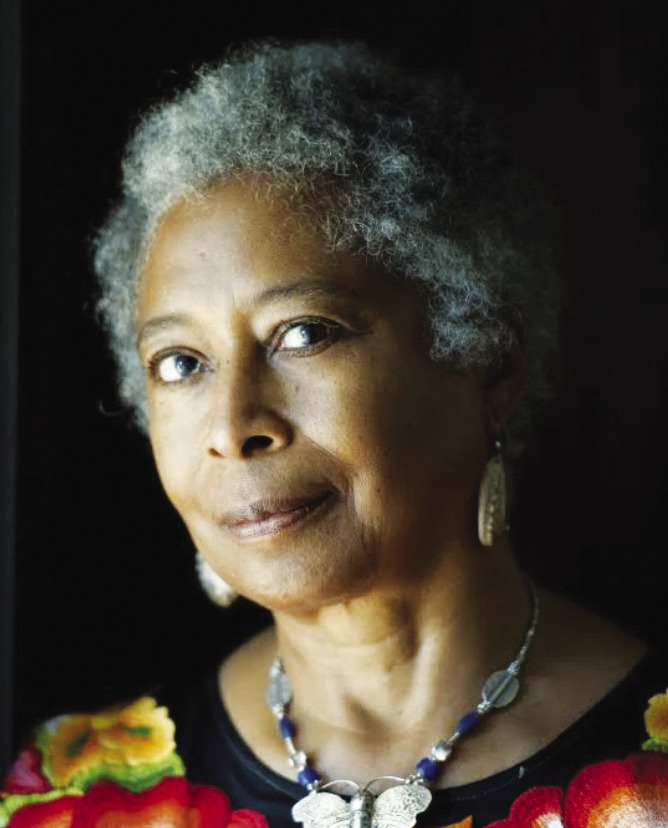
Alice Walker’s dedication to voter rights began in Putnam County.
The Pulitzer Prize-winning author of The Color Purple recalls a time as a young girl when she and her father walked to a Putnam County polling place — a tiny, white-owned store “in the middle of nowhere.”
As he went to cast his first vote, Mr. Walker was met by three white men holding shotguns. They were enforcing the Jim Crow “laws” that dominated the South and denied Black voters. Despite the threat of death, Willie Lee Walker cast his ballot.
Voting is a way to “live or die on your feet,” Alice Walker wrote about her views on voting today.
Stories like these will be part of Putnam County’s addition to the Smithsonian Institution’s traveling exhibit, “Voices and Votes: Democracy in America,” as part of the Museum on Main Street program, coming to Eatonton April 20 to May 31 at the county building near Hwy. 441.
The exhibit, hosted by Georgia Writers Museum and the Old School History Museum, is sponsored by Putnam County and Georgia Humanities. It will explore the history, struggles, and future of democracy through stories, photos, videos, interactives, and artifacts.
For Walker, voting isn’t just a civic duty; it’s a form of ancestral conversation. If you read her prose — deep, earthy, and uncompromising — you realize she views the ballot box as a sacred vessel for voices once silenced by the heavy soil of the American South. She teaches that a vote is a “thank you note” to those who walked miles of dusty roads just to stand in line to make their opinion heard. It’s a way to honor the “gardens” our mothers planted, often in the shadows of disenfranchisement.
Walker doesn’t treat voting as a dry, political transaction. When a person casts a vote, they are asserting, “I am here, I am whole, and my story matters.”
Through her essays and activism, she reminds us that the struggle for the right to vote was never just about pulling a lever; it was about reclaiming the right to be recognized as a human being. It represents the power to help define one’s own story rather than just being a character in someone else’s script.
Walker’s life suggests we are all stewards of this sacred right. She doesn’t just point to the law; she points to the heart. She challenges us to see voting rights not as a static achievement but as a living, breathing relationship between citizens and communities. If we neglect it, the garden withers; if we nurture it, we find ourselves blooming in ways we never thought possible.
Ultimately, Walker invites us to the table of democracy not as guests, but as rightful owners.
Follow this newspaper in the coming weeks for more detailed information on the “Voices and Votes: Democracy in America” exhibit coming to Eatonton this spring.