
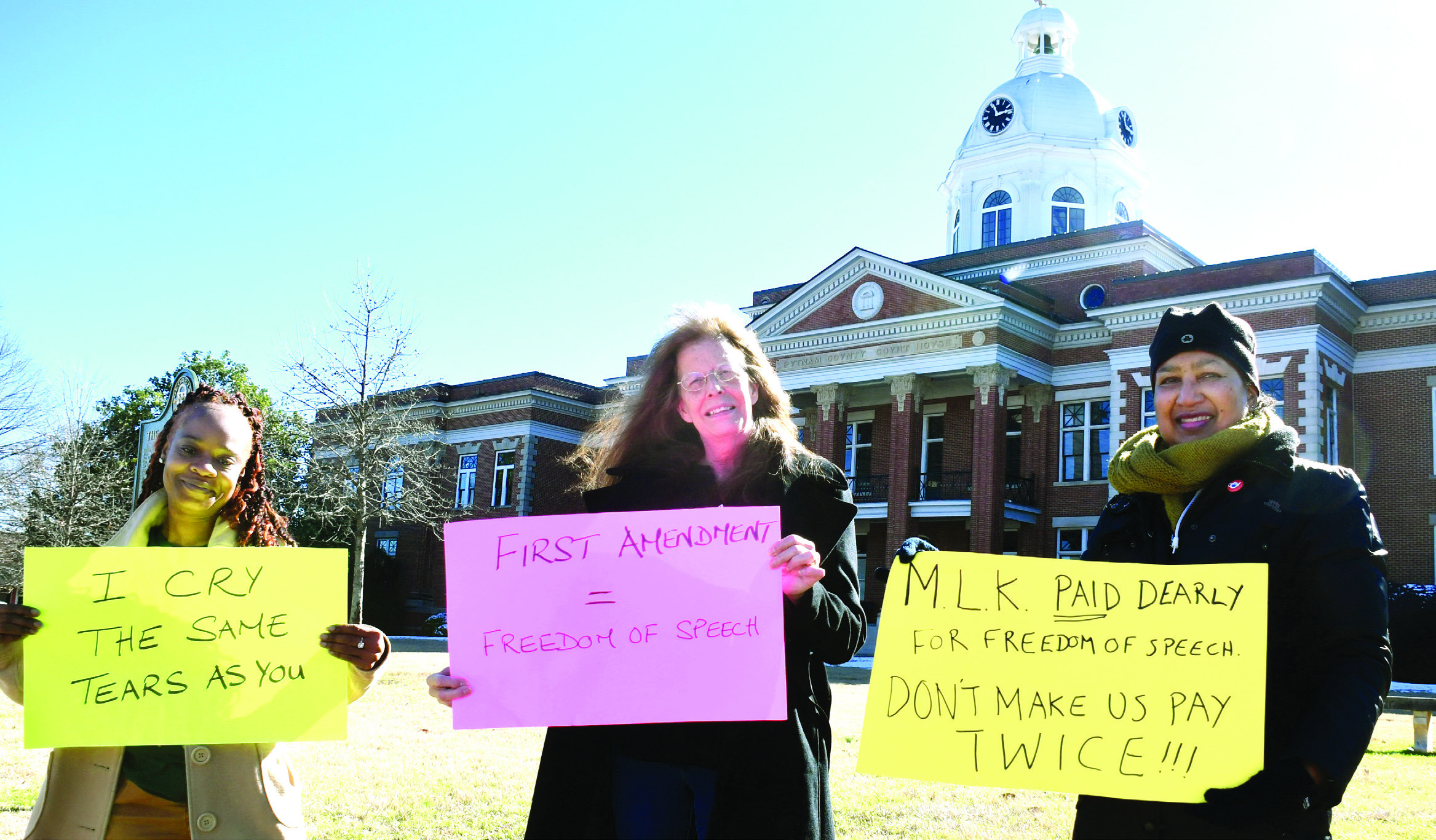
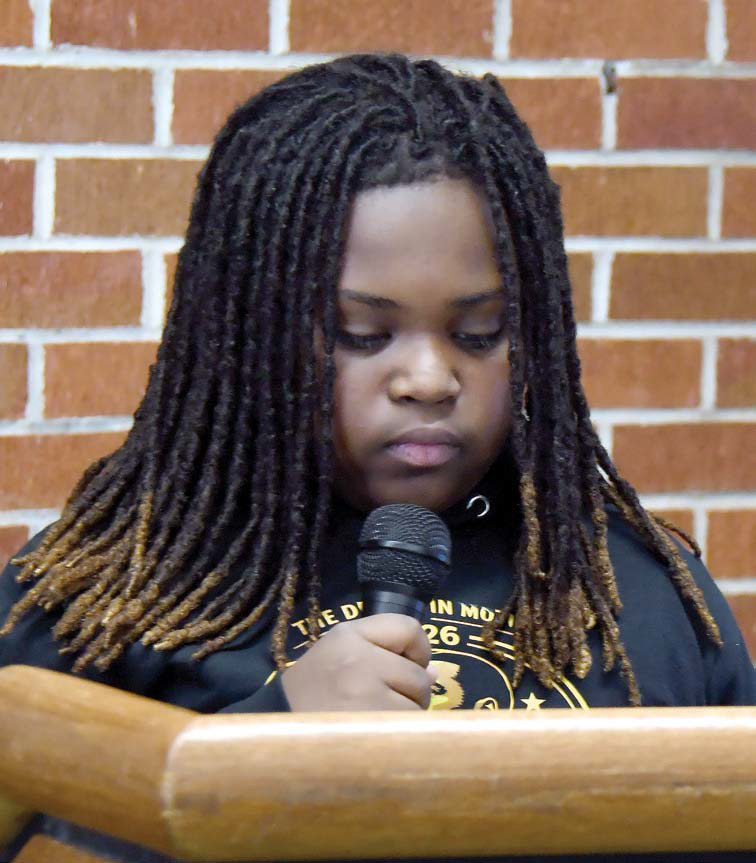
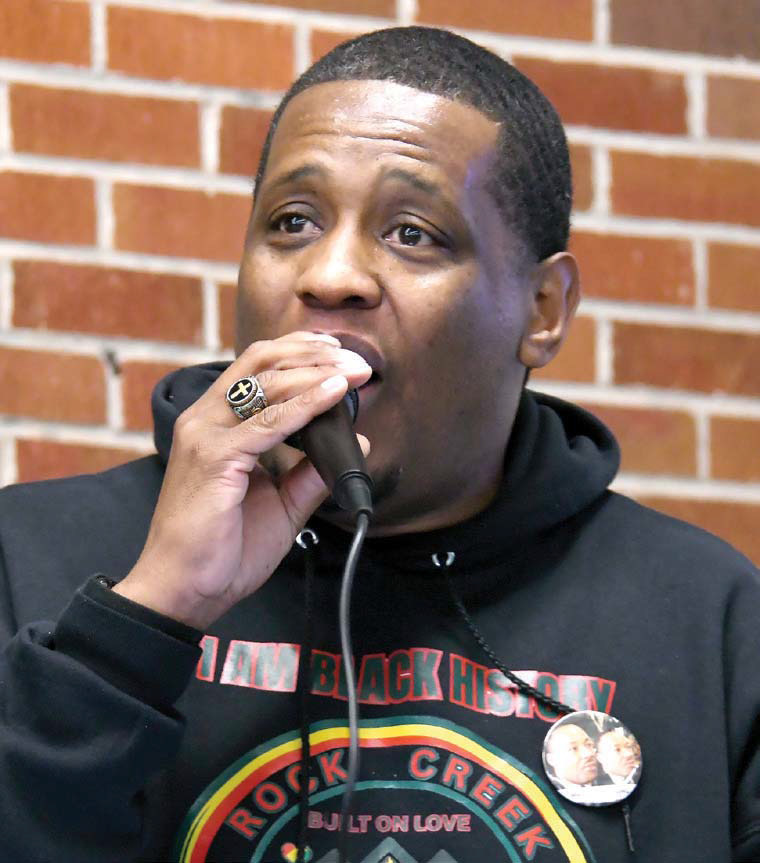
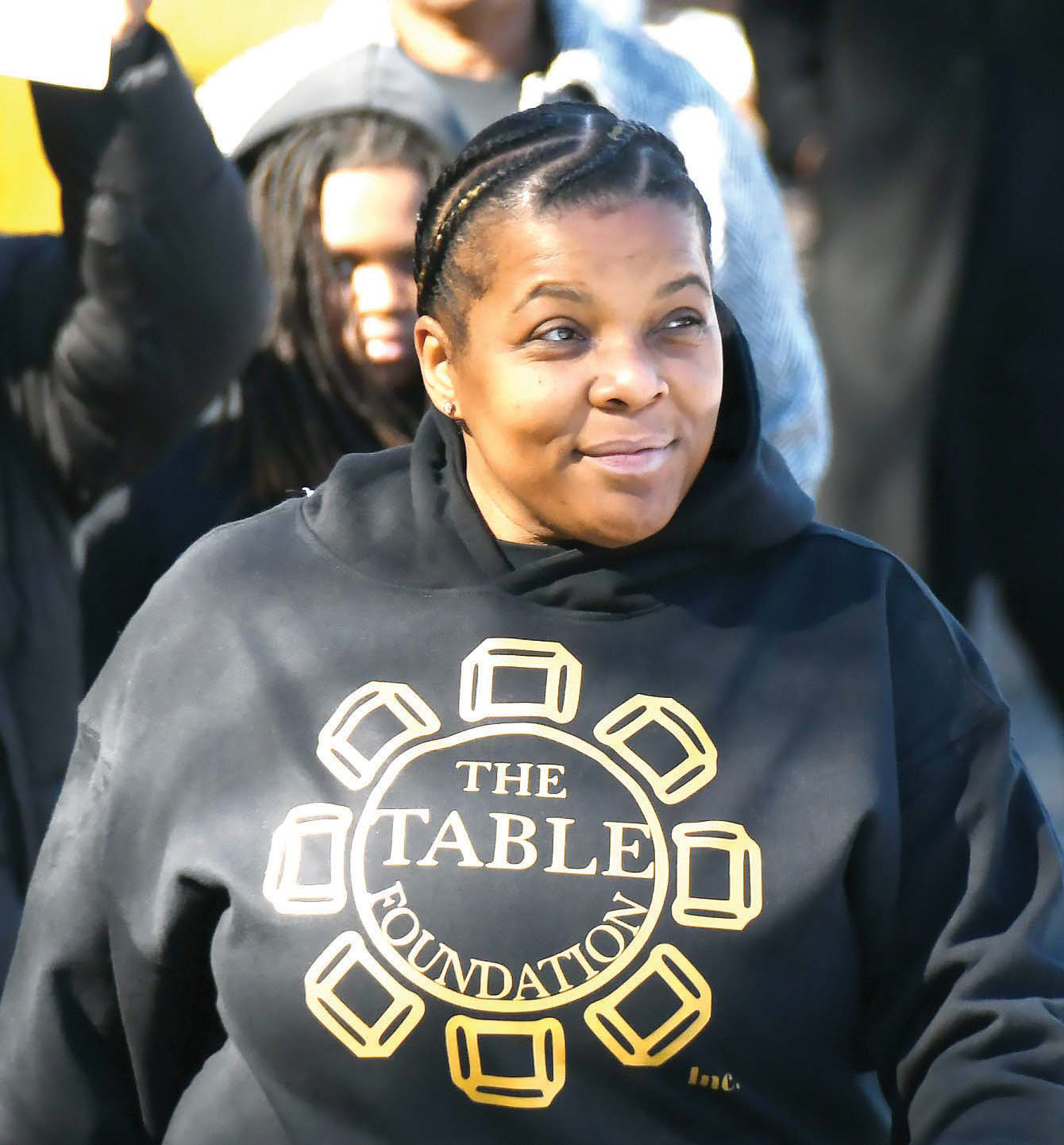
More than a commemoration of the past, Monday’s Martin Luther King Jr. Day ceremony at the decommissioned Butler-Baker School served as a sign of renewal for Eatonton’s NAACP chapter and a reminder that Dr. King’s dream, organizers said, remains unfinished work.
Approximately 150 people gathered Jan. 19 for a short march around the school grounds to accommodate several elderly participants, followed by speeches, performances, and reflections marking the national holiday in the school’s assembly hall. The event was organized by the revitalized NAACP Chapter 5229, which, only a year ago, no longer formally existed after having gone silent during the COVID-19 pandemic.
Opening the ceremony, new NAACP Membership Chair Kilee (pronounced “Keelee”) Reid framed the day as a call to action rather than a retrospective.
“We are the products of the seeds that were put in the ground a long time ago — seeds of courage, seeds of faith, seeds of resistance, and seeds of love,” Reid told the crowd. “The dream was never meant to stay on paper. It was meant to walk. It was meant to organize. It was meant to vote. It was meant to build.”
Reid, who returned to Putnam County last January to care for her grandmother, said the ceremony reflected the chapter’s broader mission of reconnecting Dr. King’s legacy to present-day civic involvement. A Georgia State University alumna with a degree in political science, she joined the local NAACP in August and quickly began advocating for broader participation, particularly among younger residents.
“At the time, meetings had maybe 10 people, mostly retirees,” Reid said following the event. “There was about a 40-year age gap. I pitched that we needed younger people involved, and from that conversation, they asked me to oversee membership.”
Since then, the chapter has grown to nearly 40 members, with Reid setting a goal of reaching 100 by the end of this year. She said she was impressed by Monday’s turnout, both in size and diversity.
“I was really shocked — in a good way,” Reid said. “I’ve never seen so many younger people here before. The diversity across ages and races was really encouraging.”
The event included a short march around the Butler-Baker campus, intentionally designed to be accessible for seniors, with golf carts available. Younger participants, including children, also took part, a point Reid said was especially meaningful.
“We’re looking to start a Junior NAACP chapter eventually,” she said. “Kids join for free, and it gives them a voice. We think we know what kids want, but sometimes they’re into things like entrepreneurship, content creation, writing, or videography. We need to hear from them.”
Putnam County District 2 Commissioner Richard Garrett, who also serves as treasurer of the revived NAACP chapter, said the organization's return fills a noticeable gap in the community.
“It died off during COVID,” Garrett explained. “People couldn’t meet, enthusiasm faded, and it took time to work through the formalities of reestablishing it with the state and national NAACP. But years ago, this chapter was very active and well-received. Its absence was felt.”
Garrett described Eatonton’s MLK Jr. Day ceremony as a longstanding tradition, though it has shifted locations over the years. He said maintaining its relevance remains a challenge.
“Everyone grounds themselves in the significance of Dr. King,” Garrett said. “However, the hard part is asking what we’re trying to accomplish now. Segregation was an obvious target in his time, so integration was the goal. We’ve come a long way with that, but we clearly haven’t reached a promised land.”
Garrett noted that while attendance was strong, the crowd did not fully reflect Putnam County’s predominantly white demographics.
“Only about five percent of the attendees were white in a county that’s roughly 75 percent white,” he pointed out. “That’s something we need to wrestle with. This is a federal holiday — the only one named after a contemporary individual. It really should be a countywide event.”
Garrett suggested future ceremonies might regain prominence by returning to the Putnam County Courthouse in downtown Eatonton, where earlier MLK events were once held.
“That location gave it visibility,” Garrett said. “I’d like to see it become something everyone marks on their calendar.”
Reid echoed the sentiment, emphasizing that meaningful change depends on sustaining engagement beyond annual observances.
“Systemic racism is harder to fight because you don’t always know where to enter the battle,” she said. “But showing up matters. Going to city council meetings, county meetings, knowing how your tax dollars are spent; that’s all part of the work.”
As the ceremony concluded, Reid returned to the question she posed at the outset.
“The same question history once asked Dr. King is now quietly being asked of each one of us,” she said. “What will you do with the seeds you inherited?”