

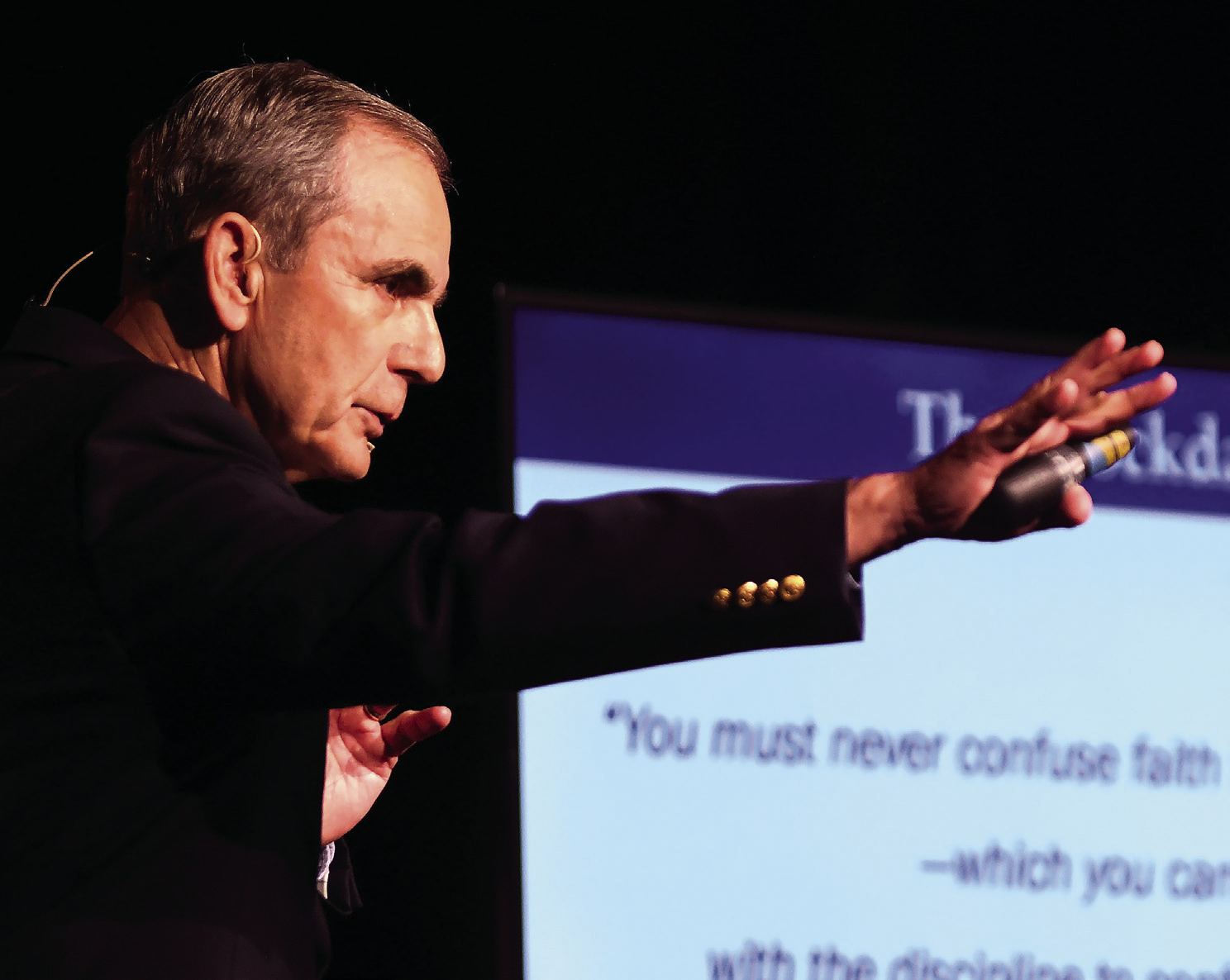
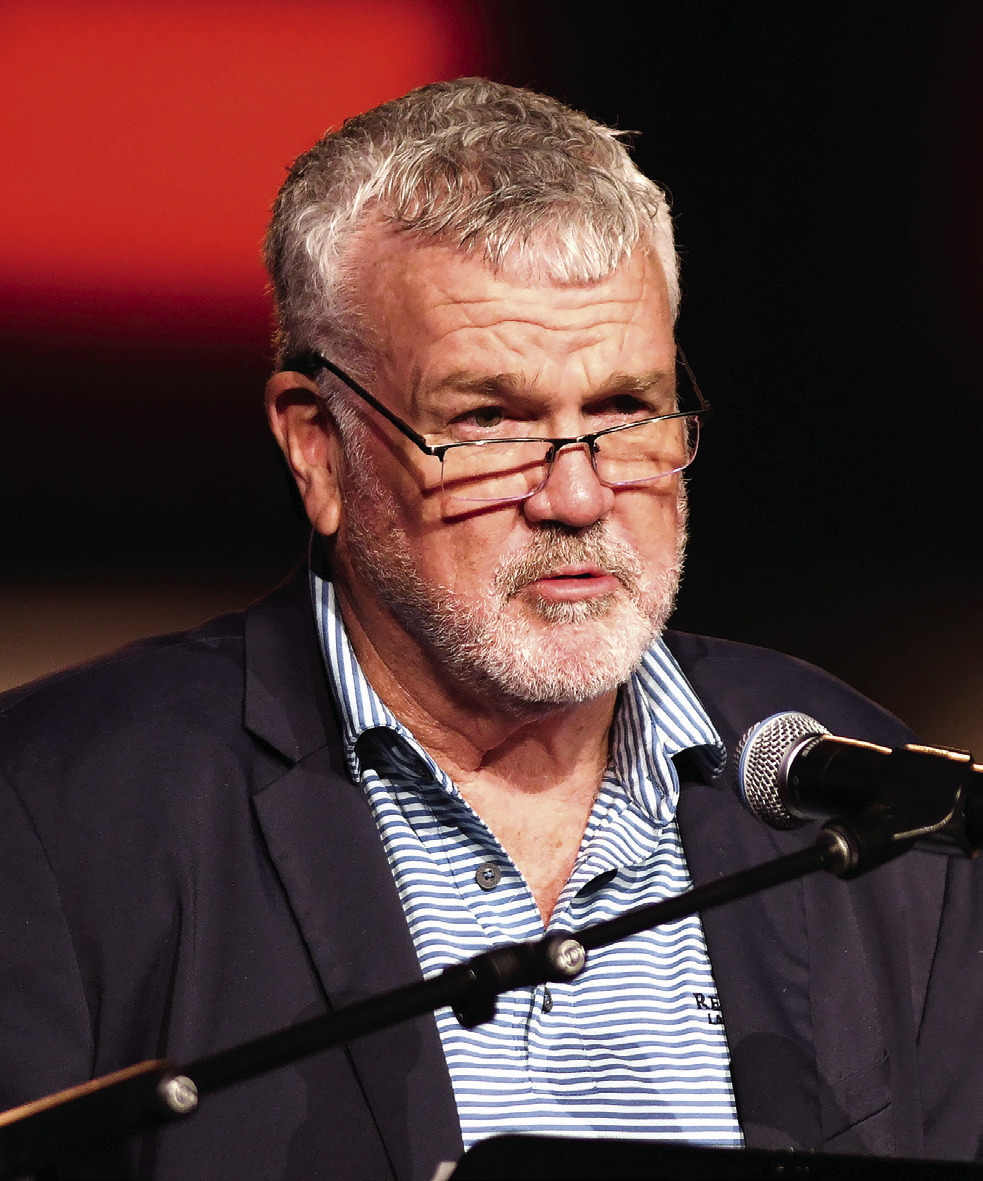

Following an introduction by BankSouth President and CEO Harold Reynolds, retired U.S. Air Force Col. Lee Ellis took the stage at Lake Oconee Church last Thursday evening, where he presented “Leadership Lessons from the Hanoi Hilton,” a harrowing tale of courage, character, and resilience.
Ellis took his stories even further, however, translating them into real-life lessons for approximately 130 rapt audience members, most of whom no doubt held their own first-hand memories of the Vietnam War era, whether stationed overseas or sitting at home watching nightly coverage of the world’s first televised military conflict.
Ellis grew up in Commerce and said that the first time he sat in an airplane, at the age of 5, he knew he wanted to become a pilot. He achieved his goal upon graduating from the University of Georgia in 1965 and joining the U.S. Air Force. During a slide presentation accompanying his talk, Ellis showed a late-1950s photo of himself plowing a field behind a horse alongside an image of a squadron of USAF F-4 Phantoms to depict his rapid progression over just six years graphically.
It all came crashing down, quite literally, however, in November 1967 when Ellis, serving with the 366th Tactical Fighter Wing, was forced to eject over North Vietnam while flying his 68th combat mission. Ellis was careful to emphasize, too, that he was not shot down but instead was the victim of a faulty bomb fuse that triggered a bomb less than two seconds after he’d released it.
“The cockpit was tumbling end over end … so me and my partner in the airplane, both pilots, we jumped out, ejected, … just doing what I was trained to do … so I landed my parachute landing … wasn’t too badly injured, just some cuts and bruises on my body,” he recalled.
“There was a bomb crater there, an old bomb crater about three feet deep, and I jumped in it,” Ellis continued. “Well, I was captured within two minutes, and they stripped me down, gave me my flight suit back, didn’t give me any shoes, tied my hands behind my back and put a blindfold on me, and put a rope around my neck like the lead of a dog. And then they started dragging me around.”
After spending 1,955 days as a prisoner of war (POW), Ellis was finally freed in March 1973, just one month shy of the Vietnam War being declared officially over.
During his five-and-a-half-year stay at the ironically nicknamed “Hanoi Hilton,” Ellis said he and his fellow U.S. servicemen captives developed several methods to cope and remain alive despite repeated rounds of neglect, starvation, and explicit torture.
“We were willing to sacrifice and to take torture to keep our ethics and to live up to the code of conduct and not give the enemy any information and not make them any propaganda,” Ellis explained in his presentation. “That was a very important message and lesson for us, and we really grew more every day. That’s what happened in the POW camp.”
Ellis described his cell, shared with three other POWs, as being approximately six-and-a-half feet by seven feet in size, with no bathroom facilities other than a plastic bucket in the corner.
“When you’re in a cell like that with four guys for eight months, 24 hours a day, except when you’re taken out and being interrogated or tortured, you get to know ‘em pretty well,” Ellis said.
To help cope, he and his fellow POWs also created a system of hand signals to converse silently and covertly among themselves. It was a lesson in cooperation that remains with him to this day.
“We had shortcuts and abbreviations a long time before the internet came along,” Ellis said. “You’ve got to develop your people, you’ve got to believe in them, and you’ve got to develop yourself.”
Ellis lived what he preached. Even while imprisoned, he recited poems he had memorized from his days as an English major at UGA. He said he also memorized in alphabetical order the names of more than 150 other POWs. He also learned Spanish and German from fellow U.S. POWs.
“I don’t care who you are or how old you are; you’ve got to keep learning and growing,” he told his Greensboro audience.
Ellis hosted a brief Q&A session following his talk, providing a unique opportunity for attendees to reflect and share personal stories of connection to the Vietnam War era. Several touching testimonies from the audience highlighted the emotional and historical impact of Ellis’s message.
Following the program, a reception in the Lake Oconee Church lobby provided guests with the opportunity to speak directly with Ellis, have one or all three of his books signed (leadingwithhonor.com), and connect further with others in attendance. Many lingered in conversation, expressing their appreciation for the event’s message.
“This was our first time doing an event like this at a completely new location, and everyone made it appear as though we did this all the time,” BankSouth Chief Administrative Officer Rebecca Matthews said. “I think the event was very impactful for the attendees. Any time you elicit an emotional response from the audience, you know you touched a chord.
“We are thankful for the BankSouth volunteers who helped make this happen and, of course, Lake Oconee Church for their hospitality in hosting the event,” she added.