
A Wisconsin-based aggregate company is proposing to open a large granite quarry in Putnam County.
It’s an ambitious project that its president said will take almost two years to implement, will operate for at least 75 years, create up to 85 jobs locally, and eventually will leave behind a 90-acre reservoir that could serve as a future drinking water reservoir and/or recreation area.
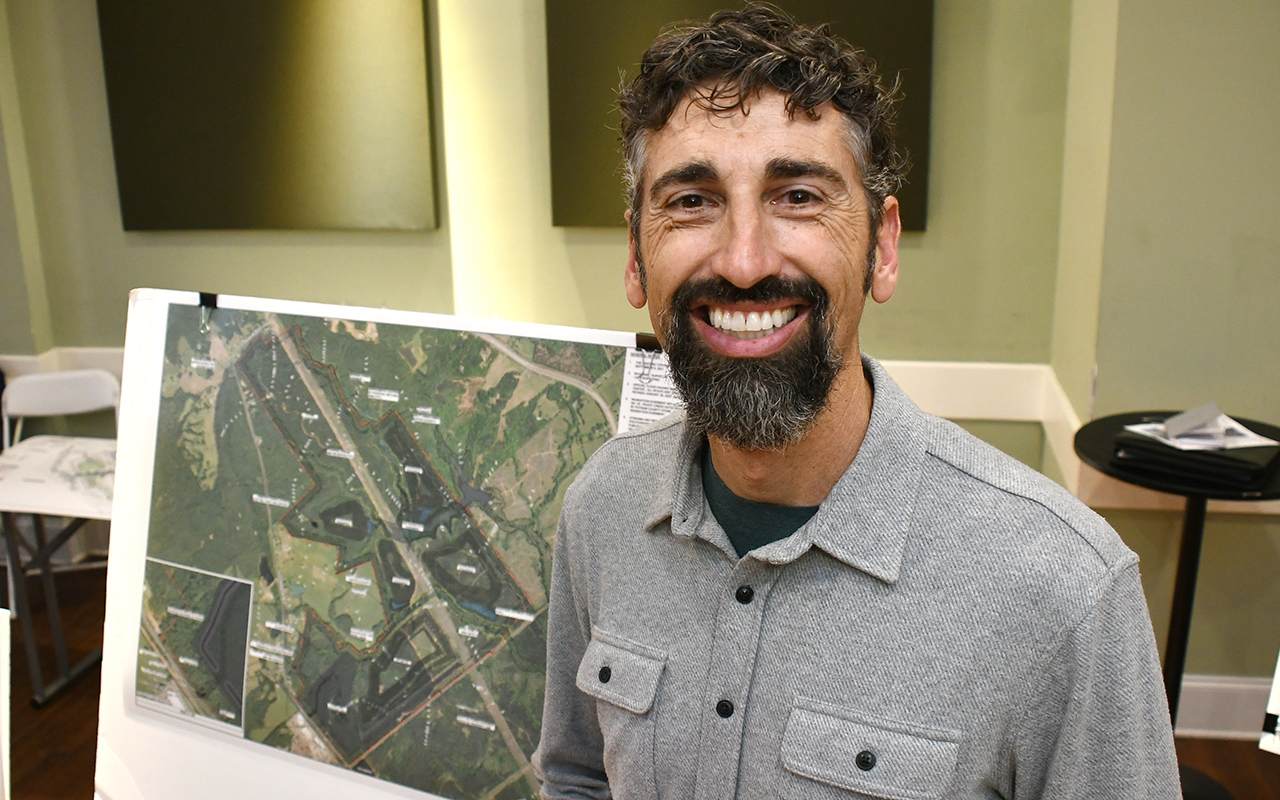
Hans Dawson, the 46-year-old president of Wisconsin-based Land and Stone Products and a co-owner of Putnam County Stone (PCS), outlined the plan during a lengthy open house information session that began at noon last Thursday at The Plaza Arts Center in Eatonton. It attracted a steady flow of interested, somewhat concerned would-be mine neighbors and other county citizens.
The company has formed a joint venture with Turnkey Process Solutions, a Nashville-based firm that specializes in quarry processing and development. The land in question, a 917-acre timber tract owned by Weyerhaeuser alongside Dennis Station Road and opposite the Interfor lumber mill, would be leased by PCS for the quarry.
Of the total acreage, Dawson emphasized that less than 10 percent would ultimately be excavated.
“Ninety-one acres will be the full extent of the pit when we’re completely finished. The rest will remain largely as timberland and buffer,” a point he stressed repeatedly in response to concerns that the entire tract could one day become a sprawling mine.
According to Dawson, drilling and geological analysis over the past year identified the southeastern corner of the property as loaded with high-grade granite that meets Georgia Department of Transportation specifications.
Upon full development, the quarry could reach a depth of up to 400 feet, much deeper than nearby Lake Sinclair, which is only about 90 feet in depth at its southernmost point beside the dam in Milledgeville.
Dawson explained the granite’s depth allows the relatively small 91-acre active mining footprint to supply material for decades. When mining eventually concludes, the pit it leaves behind will gradually fill with rainwater and groundwater, he added, eventually forming a 90-acre lake that the company has already agreed to allow the county to take over as a reservoir in the distant future.
“We change the land; we don’t wreck the land,” Dawson stated.
Still, the impact of mining on local groundwater has drawn scrutiny from local critics, which Dawson acknowledged. However, he added, the company hired hydrogeologists to conduct pump tests and modeling, drilling more than 400 feet to study underground aquifer conditions.
“They drill two arrays of holes and then do pumping tests where they can model what the impacts could be outside of the pit,” he explained shortly after 6 p.m. as The Plaza event was winding down.
According to the modeling, Dawson said, the operation should not affect neighboring wells. To provide additional assurance, he said the company has pledged to install monitoring wells around the site and offer monitoring equipment to nearby homeowners.
“If anything were to happen to somebody’s groundwater, we will cover a replacement well or get them water at no cost to them,” Dawson said, adding the commitment has been submitted to the county in writing, too.
Dawson acknowledged that blasting and airborne silica dust are additional concerns associated with granite quarry operations, but, as before, he stressed that modern blasting methods bear little resemblance to decades-old practices.
Now, instead of one big, rock-splitting, ground-shattering blast, 60 to 80 blast holes are drilled and filled with smaller explosive charges timed by individual computer chips to detonate about five to 12 milliseconds apart, dramatically reducing residual vibration.
Dawson said the closest Putnam County home to where blasting will occur is just over 2,200 feet away, which should isolate it from seismic vibrations. He added, too, that even if the house was affected by blasting vibration, it should only be equal to heavy footsteps upon the floor, measuring “about one-tenth the state limit,” he claimed.
As for silica dust, Dawson acknowledged it is a potentially dangerous concern for employees at the mine, but stressed that PCS will strictly adhere to, or exceed, all state and industry safety laws and standards.
“Laws exist to protect employees working just a few feet from crushing equipment that are far more stringent than for conditions experienced by neighbors thousands of feet away,” he said. “One of our most important employees is the water truck operator who sprays down the roads and surfaces first thing every morning to keep the dust away.
“We have to keep our employees safe through the end of their careers, so every precaution is taken,” Dawson continued. “When somebody is 2,000, or 3,000, or 10,000 feet away, they are completely safe. There is no danger for them.”
Economically, the project would involve an initial investment of nearly $30 million to open the quarry, with future phases potentially adding another $10 to $15 million. Dawson said the site would employ about 15 workers directly at a minimum wage of $25 an hour. He estimated that an additional 70 jobs will be created through trucking and support services as well.
The company estimates it will pay approximately $330,000 in local taxes per year, and Dawson emphasized that it is not seeking public subsidies.
If approved by the Putnam County Board of Commissioners, the project would move into state permitting with the Georgia Environmental Protection Division, followed by detailed engineering.
Dawson said he expects state testing and permitting to take up most of 2026, and the company hopes to break ground early in 2027 to begin sales by the end of next year.
“I really want to be the type of company that people are very proud to have in their community,” Dawson stated. “I really want us to be great neighbors.”
Whether Putnam County residents ultimately share that view is likely to be decided in the weeks, months, and years ahead.