

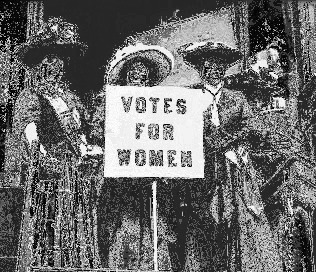
Did you know Georgia was the first state to reject the ratification of the 19th Amendment in 1920, giving women the right to vote? And the state did not officially ratify the 19th Amendment to the U.S. Constitution until 1970?
The Smithsonian Institution’s “Voices and Votes: Democracy in America” traveling exhibit will debut in Eatonton with a soft opening for educators on April 20, and then open to the public from April 25 to May 31.
Hosted by the Georgia Writers Museum, the Old School History Museum, and Georgia Humanities, this massive exhibit will explore the origins of American democracy, including the fight for women’s suffrage, protest, and civil rights.
Women’s suffrage in this country kicked off in earnest in the 1890s. However, while the rest of the country was starting to hum with the spirit of reform, Georgia was a bit more set in its ways. But then came leaders like Gertrude Thomas, Rebecca Felton, and Helen Augusta Howard, who led a winding, uphill climb, fueled by courage and persistence.
Augusta Howard was a true firebrand who convinced the National American Woman Suffrage Association to hold its 1895 convention in Atlanta. She brought the national spotlight to the South, proving that leadership isn’t about title, it’s about presence. A true pioneer, Augusta Howard went on to become the first female U.S. Senator.
The movement wasn’t just about a ballot, though. It was about the right to be heard and to serve the community fully. In the early 1900s, groups like the Georgia Young People’s Suffrage Association began to sprout. These women weren’t just protestors; they were educators. They knew that to change minds, they had to provide charm and diplomacy to the cause — making the case for equality with grace, logic, and relentless energy.
Black women in Georgia were also crucial to the women’s suffrage movement, forming organizations like the Georgia Federation of Colored Women’s Clubs. Despite segregation, both races came together within Black communities to advocate for voting rights and fight racial discrimination while working for broader social uplift.
When the 19th Amendment was finally ratified in 1920, Georgia’s reaction served as a reminder that progress often faces a stiff headwind. Georgia women couldn’t vote in the 1920 presidential election because of “requirement hurdles.” It took until 1922 for the state to finally allow women to the polls, and then a staggering 48 years for the state legislature to formally ratify the amendment.
The lesson here? Real partnership — the kind that moves a society forward — requires patience and a refusal to be sidelined. These women didn’t wait for permission to be leaders; they led until the law had no choice but to follow. They were leaders filled with the purpose of a noble cause, courage to buck a flawed system, and the resilience to stay with it until their right to vote was realized.
These stories and more will be fully explored and explained by The Smithsonian’s “Voices and Votes: Democracy in America.” Mark your calendar now and make sure not to miss this important, unique opportunity to experience the major exhibit debuting soon in Eatonton.