
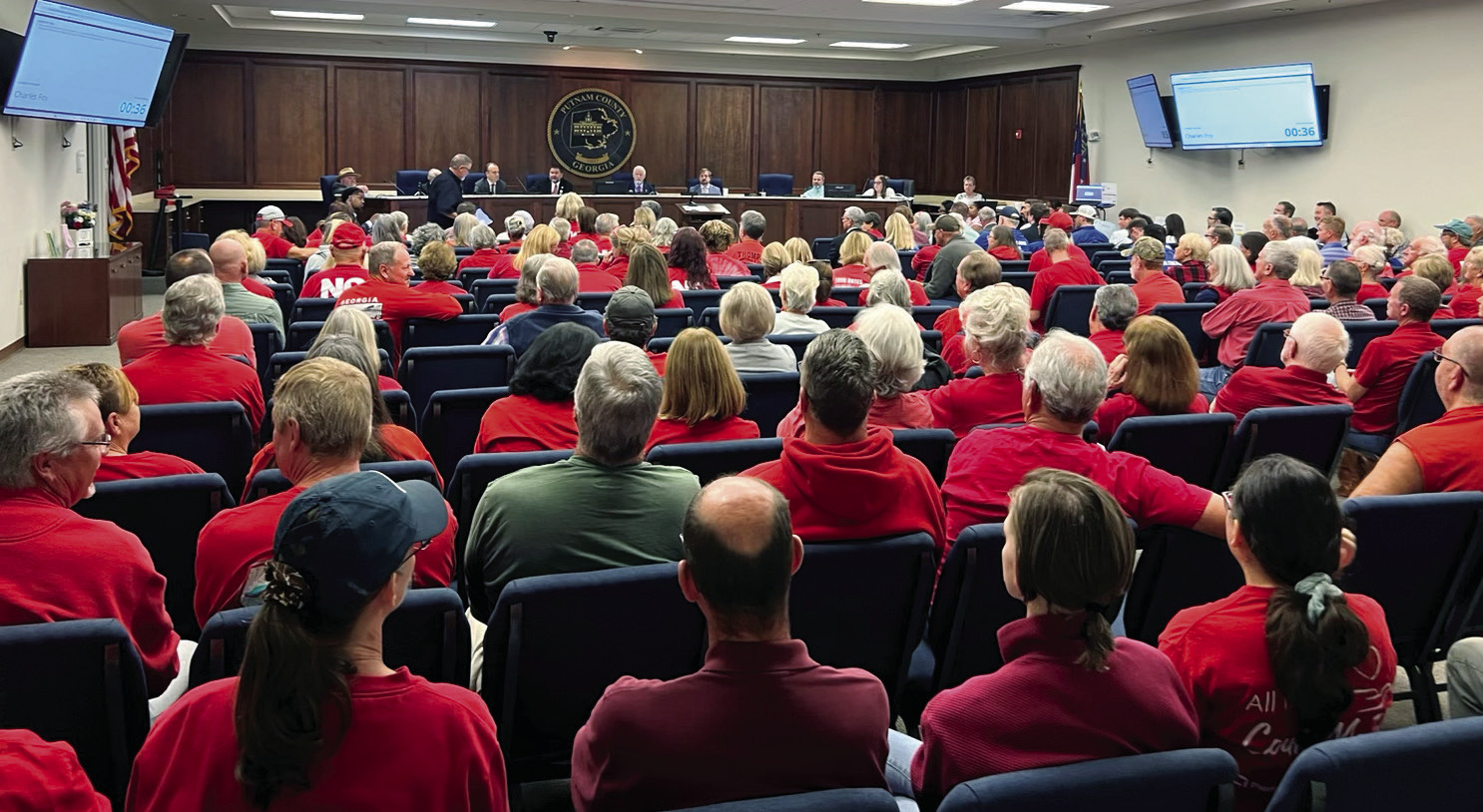
Putnam County commissioners unanimously rejected a proposed granite quarry on Dennis Station Road Oct. 20, following a nearly four-hour meeting marked by competing expert testimony, emotional appeals, and warnings that the project would permanently change the character of the local community.
Sheriff Howard Sills, the first speaker, opposed the quarry, predicting additional traffic accidents and describing the controversy as exceptionally divisive.
“I don’t think anyone’s caused as much problem since Sherman went on to Savannah,” Sills quipped, drawing applause. He also urged restraint. “Whatever this outcome is, I want you to act like you got some home training,” he told approximately 180 people who attended the meeting.
Commissioners voted 4-0 to deny Putnam County Stone LLC’s request to rezone 342.87 acres of Weyerhaeuserowned land from agricultural to industrial- manufacturing. County planning staff and the Planning & Zoning Board had previously recommended denial, too.
Applicant and quarry owner Hans Dawson argued the site across from the Interfor sawmill offered substantial buffers, transportation access, and an opportunity to supply construction materials locally while creating jobs and tax revenue.
“Please don’t accept the false choice that it’s either environmental protection or economic growth,” Dawson said. He also offered a contribution of 25 cents per ton sold to go toward Dennis Station Road maintenance, estimated at $125,000 annually. Proposed improvements included timber-truck queuing lanes, wider travel lanes, a right-turn-only quarry exit, and an 800-foot acceleration lane.
Dawson also brought several professional consultants with him to dispute predictions of damage and health threats from blasting, dust, and groundwater changes. They said testing indicated the quarry would cause limited groundwater effects, and the experts claimed monitoring, dust controls, and a policy to repair or replace affected wells would ensure water would continue to flow.
During rebuttal, Dawson offered to put additional testing of neighboring wells in writing.
“It’s something I’m confident in,” Dawson stated. “I’m willing to put it in writing and I’m willing to stand behind it,” he added.
Attorney Jay Dell, representing the applicant, maintained the quarry proposal met all county standards. He also challenged opponents’ evidence.
“Are there substantial reasons why the property cannot or should not be used as currently zoned? Yes. There’s 500 million reasons why,” Dell said, alluding to the estimated value of granite underground at the site.
Dell urged commissioners to judge the application, not the public pressure. He also asked whether they would let 1,900 opponents, “approximately 8% of the county, run the county?”
Opposition attorney Bill Larson, representing nearby property owners and petition signers, argued the quarry conflicted with surrounding agricultural and residential uses. He warned about sediment reaching Lake Sinclair, groundwater depletion, and disputed the quarry’s compliance with the county’s two-mile lake setback.
“We may be talking about a hypothetical quarry, but they’re talking about a hypothetical lake,” Larson said.
Dawson countered that a licensed surveyor had verified the setback through two methods.
Economist Michael Toma suggested the quarry would bring 88 jobs to Punam County, and approximately $10 million to $12 million in county tax revenue over 20 years.
Regardless, quarry opponents spoke passionately about family farms, historic buildings, wells, and lakefront investments. Glenda Ridley said her family’s adjoining property to the proposed quarry site contained four homes and four wells, with no community-water alternative.
Local real estate agent Margaret Decker said buyers were already hesitating because of the quarry proposal. “Buyer perception becomes market reality,” she said.
Sandy Decker offered a succinct, pointed response to Dell’s economic argument: “This quarry is a win-win situation. It’s a win for Hans and a win for Weyerhaeuser.”
Charles Foy dismissed the technical presentations as “boring as hell” and concluded, “Send these bastards back to Wisconsin.” Daniel Kelhoffer compared the proposed quarry to a firebreathing dragon, arguing that reducing its size did not eliminate its danger.
Speaking-time disputes also flared. Larson requested additional time, arguing that applicant consultants had effectively expanded their presentation by signing up to speak during public comments. Chairman Bill Sharp later said 29 speakers opposed the quarry, 12 supported it, and three registrants did not speak.
District 2 Commissioner Richard Garrett seconded the denial motion, saying the county’s lake-driven economy and control over future development warranted protection. “If you take preponderance of the evidence and weigh the risk, then I don’t think this rezoning is appropriate,” Garrett said.
District 1 Commissioner Tom McElhenney, who made the motion for denial, cited heavytruck safety risks, incompatibility with surrounding uses, comprehensive-plan concerns, and the site’s location within a mapped groundwater recharge area for his skepticism over the quarry proposal.
“The proposed heavy industrial extractive use due to scale intensity and long-term permanence is incompatible with the predominantly rural agricultural forestry and residential character of the surrounding area,” McElhenney stated. He concluded the proposal “would be detrimental to the public health, safety, and welfare of the Putnam County citizens and community.”