

Editor’s note: The symmetry of 52 weeks in a year and 26 letters in our alphabet inspired us here at The Eatonton Messenger to embark on an alphabetical journey of Putnam County every other week this year, looking at something – or someone – unique, significant, unusual, or just plain interesting.
Similar to, but very different from its “big brother” Rock Eagle north of Eatonton, Rock Hawk offers a history and attractions all its own just off Hwy. 16 on the east side of the county (125 Wallace Dam Rd.).
Situated amid nine acres of fenced-in property deeded to UGA from Georgia Power in the 1970s, Rock Hawk is surrounded by now Georgia Department of Natural Resources (DNR)-owned land, ensuring it will remain safe from development or encroachment.
Both Rock Hawk and Rock Eagle are centered around prehistoric bird-shaped rock effigies that were officially investigated and chronicled for the first time in 1877 by scientists from the Smithsonian Institute in Washington.
With both estimated to be up to 3,000 years old, Rock Eagle wound up being rebuilt and restored in the mid-1930s by the Civilian Conservation Corps., while Rock Hawk remains essentially as found.
Free parking at Rock Hawk leads to a long, straight walkway toward the effigy, lined on both sides by plaques depicting photos and stories of the region’s past. Though not necessarily connected to the effigy itself, the information presented provides a good insight into Putnam County’s history, going back as far as prehistoric times.
In 1950, a University of Georgia anthropologist/archeologist led some excavation at Rock Hawk; however, the activity sparked local controversy and the work quickly came to a halt, though trenches from the effort remain visible alongside the top edge of the effigy’s wings. Remarkably, as recently as the 1980s, logging trucks routinely passed by Rock Hawk, skirting the tail-end extremity of the effigy.
“If you look at the history of particularly our part of the world, people didn’t appreciate ancient things or Native American things at all, really,” Carol Shulstad said. “We didn’t start preserving things until the 1950s and ‘60s, and even then it was just in pockets, generally speaking. There weren’t any rules or laws in effect.”
Both effigies are now enclosed by fencing for preservation reasons and both feature tall observation towers for viewing from above. Additionally, the Eatonton-based Historic Piedmont Scenic Byway Corporation developed approximately 30 miles of trails surrounding Rock Hawk, and DNR built three archery ranges on the property.
Significantly, both Rock Eagle and Rock Hawk are free to visit during scheduled hours, which for Rock Hawk is a 7 a.m. opening time, seven days a week, while closing at 9 p.m. each day except Friday and Saturday at 10 p.m.
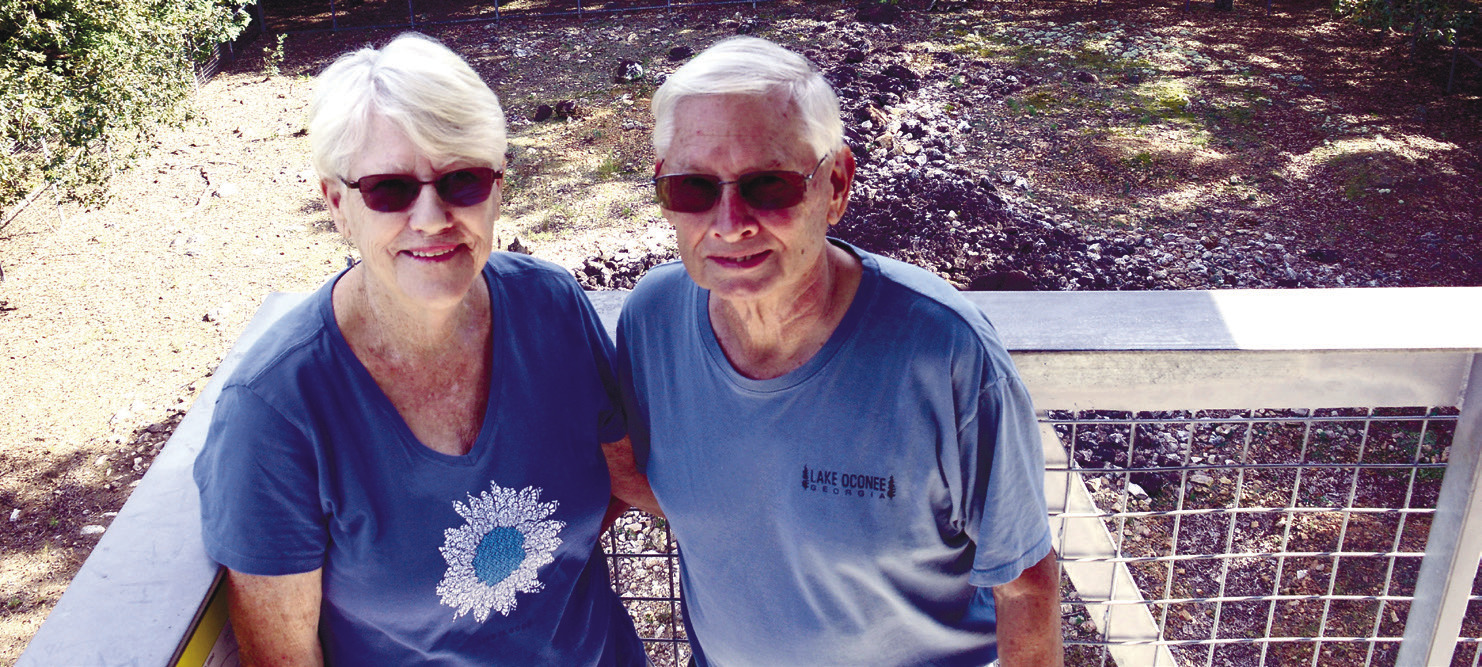
Alongside her husband Bob, Carol Shulstad is a strong advocate for Rock Hawk Park. Together they devote time monthly to making sure its information plaques remain clean and legible and generally keep watch for anything out of the ordinary. DNR staff also routinely monitor the site and are responsible for general upkeep, such as grass cutting, public restroom cleaning, and garbage removal.
Shulstad credits Putnam County Commissioner Sylbie Yon for getting former AT&T executive Larry Moore involved in the early 1990s for Rock Hawk’s revival and designation as a protected historical destination.
“She knew that he would probably put his heart and soul into preserving this – which he did,” Shulstad said.
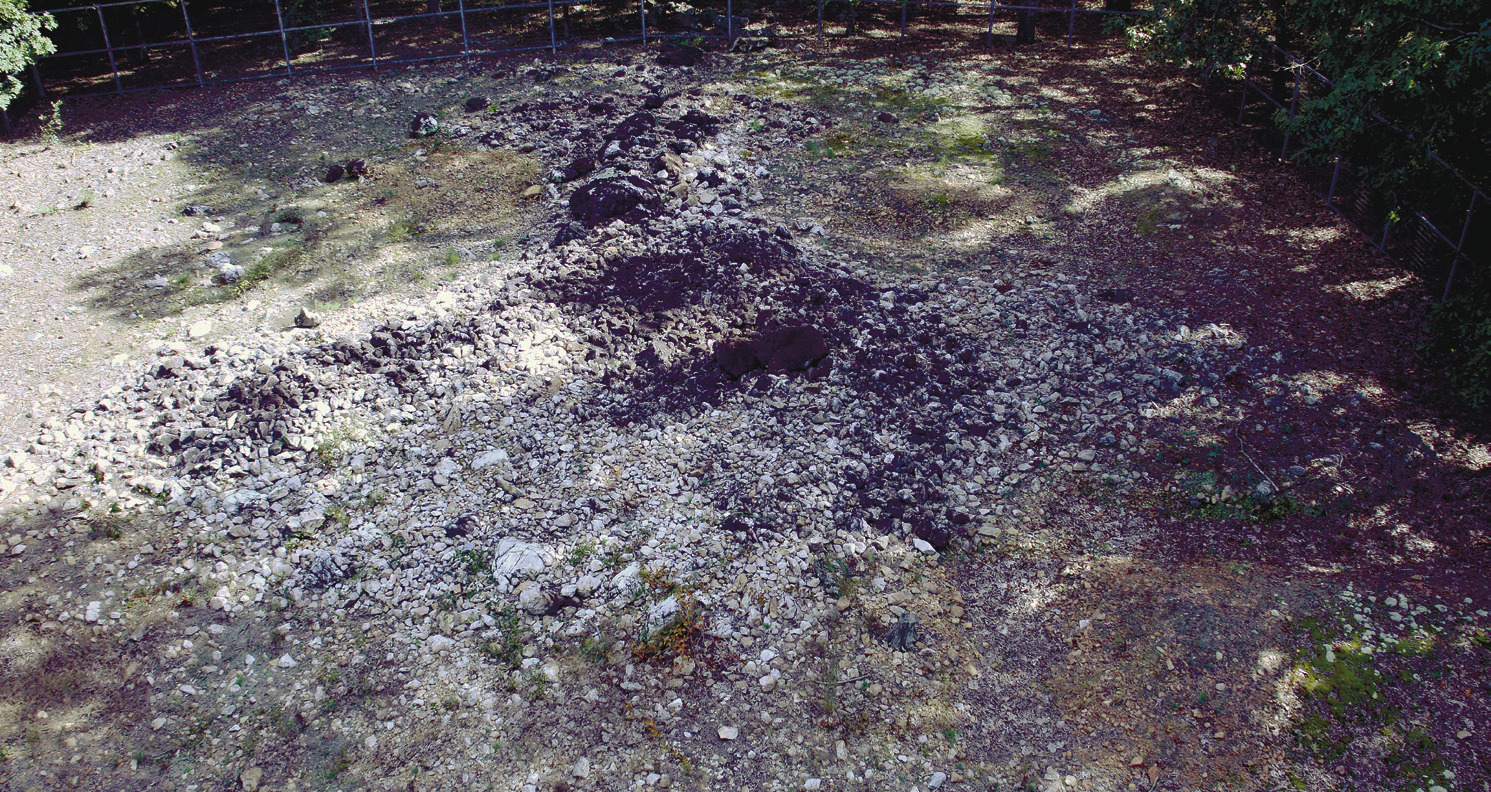
By the mid-‘90s, Moore had secured a $1 million grant from the Federal Department of Highways to build the Rock Hawk observation tower, which includes a small, unmanned museum and public restrooms at its base, plus the informational signs that dot the property. The tower provides the only view that clearly defines the shape of a bird measuring 132 feet between wingtips and 100 feet from head to tail among the seemingly random scattering of quartzite rocks.
“(The grant) was meant to save historical sites along rural routes where it might help with economic development,” Shulstad said.
She also mentioned that Moore also had to receive permission from the Muscogee Creek Nation before the grant could be awarded. She said that took considerable time, “because some of their people want (the site) to just be left alone,” however, most recognized that without intervention Rock Hawk would eventually disappear, whether due to vandalism, neglect or simply being overtaken by forest growth.
Also at the tower’s base is a 30-foot-long mural painted on plywood by student artists at Putnam County High School. It depicts the county’s history, beginning with Native American scenes at its left and progressing through the Civil War era when cotton reigned supreme, World War II with a special nod to the Tuskegee Airmen suggested by author Alice Walker, to modern times with a powerboat on Lake Sinclair. The mural originally was displayed in downtown Eatonton before being moved about five years ago to its current site.
It’s remarkable to think Putnam County is home to two man-made items that are older than the oldest buildings in Europe or Asia. In the mid-2000s video, Set in Stone, Rock Hawk, and the Historic Piedmont Scenic Byway, produced by the Apprentice Network, Moore said a visit to the site leads to not only taking away the history of Rock Hawk but also some of the mystery surrounding it.
“It would be nice if all of our histories were complete if we had all of the facts, but we don’t,” Moore said. “The mystery adds to the aura of the effigy and other historical and archeological sites. Everybody likes a story and it adds to the story, it adds to the folklore. And unfortunately, we often don’t know the difference between the history and the folklore.”
Through Friends of the Hawk, Shulstad said the most pressing issue for Rock Hawk currently is securing help to maintain and hopefully develop the site for the future. For instance, there is an ancient rock quarry nearby that she and other Rock Hawk supporters would like to see turned into a small, outdoor amphitheater for nature or history presentations.
“We could use volunteers,” she said, adding that anyone interested in helping with Rock Hawk is encouraged to send an email to her husband at bob_ shulstad@hotmail.com.