
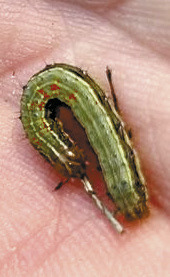
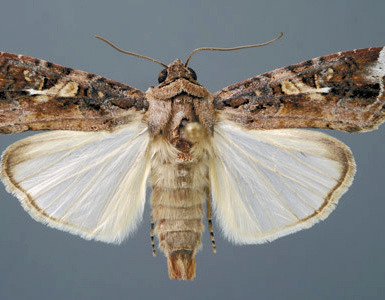
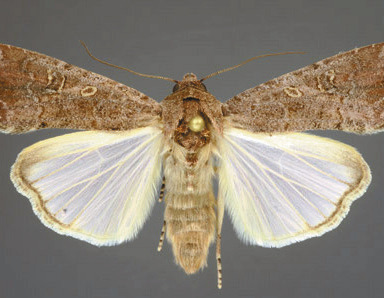
Armies are now invading Putnam County and the rest of Georgia. Specifically, armies of destructive caterpillars called fall armyworms.
The armyworms eat up an entire home lawn or farm hay pasture, forage, or row crops in no time flat.
“The last time I saw them here this bad was in 1987, and it literally took a killing frost to get rid of them,” Putnam County Extension Agent Keith Fielder said.
Local farmers began having sporadic problems “here and there across the county” at the end of June, Fielder said, and the armyworms gained momentum so that they were everywhere by the end of July.
“Now we have multiple generations on top of each other consuming everything, eating everything down to the ground,” Fielder said. “One field of grain sorghum, they completely decimated it. Once you’ve found them, you need to quickly determine what to do.”
To check your home lawn for infestation, Fielder says to walk quietly around your yard with the sun in front of you. The armyworm larvae are extremely sensitive to vibrations or shadows, so if you’re not moving softly and quietly or if your body casts a shadow on the ground, the caterpillars will quickly move down under the foliage to hide.
“Plus, having the sun shining on the ground in front of you makes them easier to see,” he added.
If your lawn is thick or the grass is taller, Fielder said you should slowly bend down and part the grass with your fingers to look for the caterpillars. For agriculture fields or pastures, don’t scout around on a 4-wheeler or tractor, but use the same method described above for lawns.
The entire life cycle of fall armyworms is about 30 days in the summer and up to twice that long in cooler months. The moths lay the eggs during the night, Fielder said, noting that the number of eggs varies but can be several hundred.
The fall armyworm moth hangs out on the bark of trees during the day, its coloration blending in with the bark. When the wings are spread, the fore wing has a darker brown coloration, and the hind wing is a more solid light color with feathery edges and an abdomen.
The larval worms feed on grasses for about two weeks. Then, they burrow down in the soil and make a loose cocoon about 2 to 4 centimeters deep. Eight to ten days later, an adult moth emerges and starts laying eggs.
“It’s absolutely incredible how fast they grow and turn over,” Fielder said. “When they get about ¾-inch long, they’re almost impossible to kill.”
Fielder said 82% of Georgia counties are infested with the armyworm right now, meaning “a great deal of damage to crops.”
“Between the armyworm and the hurricane down in South Georgia, it has just been one thing after another for farm crops this year,” he said. “The impact will be significant for all of us.”
Fielder said some pesticides that have traditionally been effective in getting rid of the armyworm are not working well in some instances, so he asks anyone who has questions on chemical choices to call him at 706- 485- 4151.
Fielder suggests reading the article using the QR code below or visiting bit.ly/4dHjYZs for more information.