
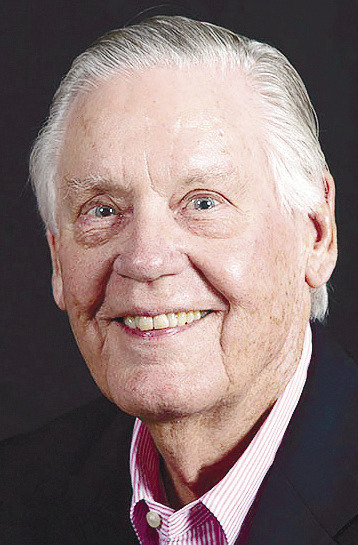
It is my sad duty to tell you, dear readers, that I have once again been denied the Nobel Prize in Literature that I so richly deserve, along with the 11 million Swedish krona (about $1 million), which I would have donated to my favorite charity – me.
And then there are the 81,380 nouns, verbs, present participles, and all that other stuff I so deftly created over the past year for your reading pleasure down the tube.
Winning the Nobel Prize in Literature would look good on my resume should I ever have to find a real job. (“And what do you feel qualifies you to handle the drive-thru window here at McDonald’s, sir? Well, I love people, and I just won the Nobel Prize in Literature.”)
A couple of years ago, the prize went to a French writer who won it for her “courage and clinical acuity with which she uncovers the roots, estrangements and collective restraints of personal memory.” I must admit that I couldn’t compete with that because I have no earthly idea what it means. I’m wondering if gobbledygook is a criterion for consideration.
Last year, it was some Norwegian guy. The committee gave him the award because they said he “blends a rootedness in the language and nature of his Norwegian background with artistic techniques in the wake of modernism.”
Yes, I do believe gobbledygook is a criterion for consideration. Why can’t they just say he writes really good stuff?
And now, after waiting all year in anticipation for the call informing me of being this year’s winner of the Nobel Prize in Literature and having scribbled out some notes telling the committee how humbled I was that they had recognized my abilities to uncover the roots of collective techniques in estranged modernism (hey, I can gobbledygook with the best of them), the call never came.
Instead, the prize went to a novelist in South Korea named Han Kang. First, France, then Norway, and now South Korea. Do I see a trend here? Americans need not apply. Is our rootedness not good enough for them?
By the way, Bob Dylan was the last American to win in 2017 for “creating new poetic expressions within the great American song tradition.”
The Nobelists had never heard of Ray Charles Robinson of Albany, Georgia. That is their loss. There is no more poetic expression within the great American song tradition than hearing my man sing “Georgia on My Mind,” the greatest state song in the history of the world.
The committee said Han Kang was honored this year for “her intense poetic prose that confronts historical traumas and exposes the fragility of human life.”
How so? She is best known for her novel “The Vegetarian,” which I had assumed was a story about somebody who chose to eat sea sprouts instead of nutritious pork rinds. Not to seem petty, but that doesn’t sound like Nobel Prize in Literature stuff to me.
It turns out “The Vegetarian” isn’t about that at all. It is about a depressed housewife who shocks her family when she stops eating meat. Later, she decides to stop eating altogether, and if that’s not bad enough, she then decides to turn into a tree. I’m unsure what kind of tree it was, but that didn’t matter to the Nobel committee. To them, a tree is just a tree so long as it has roots.
Fortunately, I still have time to figure out what I am doing wrong and how to fix it. Nobles have been given to folks as old as 97.
This assumes that if I make it to 97, I may have finally figured out where to put commas, which should impress the judges. I am not confident, and neither is my editor.
Maybe they don’t understand Southern in Stockholm, where the Nobel Foundation is located. That wouldn’t be a big surprise.
People don’t much understand the Southern north of Richmond.
Of course, there is the possibility that I won the thing and the election was stolen from me by a bunch of immigrants who eat cats. This would not be the first time something like this may have occurred.
You can reach Dick Yarbrough at dick@dickyarbrough.com, or P.O. Box 725373, Atlanta, Ga. 31139