
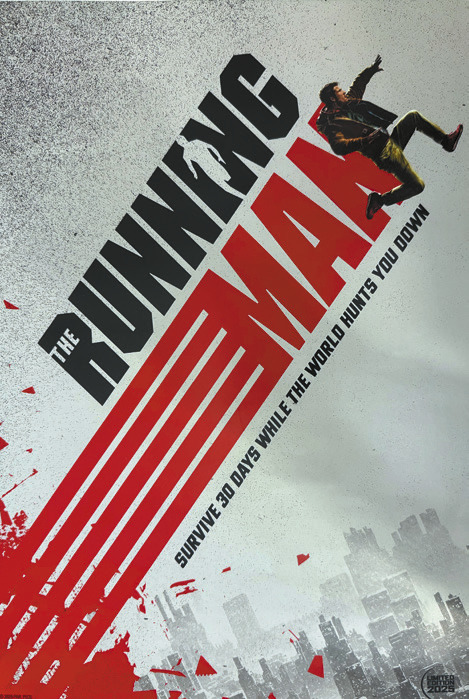
It’s not possible to watch Paramount’s new movie “The Running Man,” based on a short 1982 novel of the same name by horror master Steven King (under the pseudonym Richard Bachman), without equating it to the political/entertainment climate we find ourselves in today.
Coincidentally, King/ Bachman even set the novel in the then far-off future of 2025. How’s that for a start?
And no, this is not a rehash of the 1987 film of the same name starring Arnold Schwarzenegger, though the basic premise remains that the lead character, Ben Richards, is competing in “The Running Man,” a life-or-death, televised, reality-TV game show catering to the bloodlust of the masses.
In Richards’ dystopian world of totalitarian control by corporate overlords, a monetary system eerily echoing that of cryptocurrency, rabid “fans” bent on seeing bloodshed and death amid a backdrop of an almost complete loss of humanity, it feels like a figurative mirror is being held up to current real-life societal conditions.
Our hero has to constantly outwit or battle roving squads of government-sponsored thugs in imposing assault vehicles, decked out in identity cloaking masks, armed to the teeth, and motivated to impose their will by any means necessary.
Sound familiar?
This time around, “The Running Man” stars Glen Powell (who recently starred as Tom Cruise’s main rival in “Top Gun 2”) as a down-on-his-luck dad pushed to desperate measures in order to pay for expensive medicine for his sick daughter.
Once selected for the fictional TV show, its producer, played by James Brolin, remains in regular contact with Richards and pushes him to ever more extreme measures as his popularity — with fans rooting both for and against him — grows with each passing day.
Of course, along the way, Richards blows up a lot of stuff and kills a lot of people in various, creative ways while simultaneously remaining a family man at heart who really just wants to be left alone. Right down to his dirty hoodie, Richards frequently reminded me of Viggo Mortensen starring in director John Hillcoat’s post-apocalyptic masterpiece “The Road.”
I watched “The Running Man” in a near-empty theater, accompanied only by a young couple a few rows in front of me, so there was no way to measure any of the movie’s audience reactions.
Afterward, however, I asked the couple what they thought of the experience. The young lady said she wasn’t prepared for the level of violence the movie depicted. Still, not surprisingly, both mentioned their undeniable nods to the prevailing political and societal atmospheres, from Washington on down to what’s being shown on TV these days.
They agreed with me, too, that the dialogue occasionally devolved into the corny, and the action became almost cartoonishly violent. We also decided that it sometimes felt like director Edgar Wright momentarily lost the handle on the flick as a social commentary, as it bordered on the absurd.
Still, this movie effectively explored the economic desperation so many “common folks” like Richards felt and faces. It also provided a behind-the-scenes glimpse at the artificial intelligence fakery that is already spouting potentially harmful disinformation to each of us daily. It’s becoming ever more challenging to be sure what’s real or not, which, unfortunately, is something we will all have to cope with more and more as our future becomes the present.
Despite King’s eerie accuracy in writing the novel more than four decades ago, hopefully, this version of “The Running Man” will not become a predictive pop culture reference for our true future.