
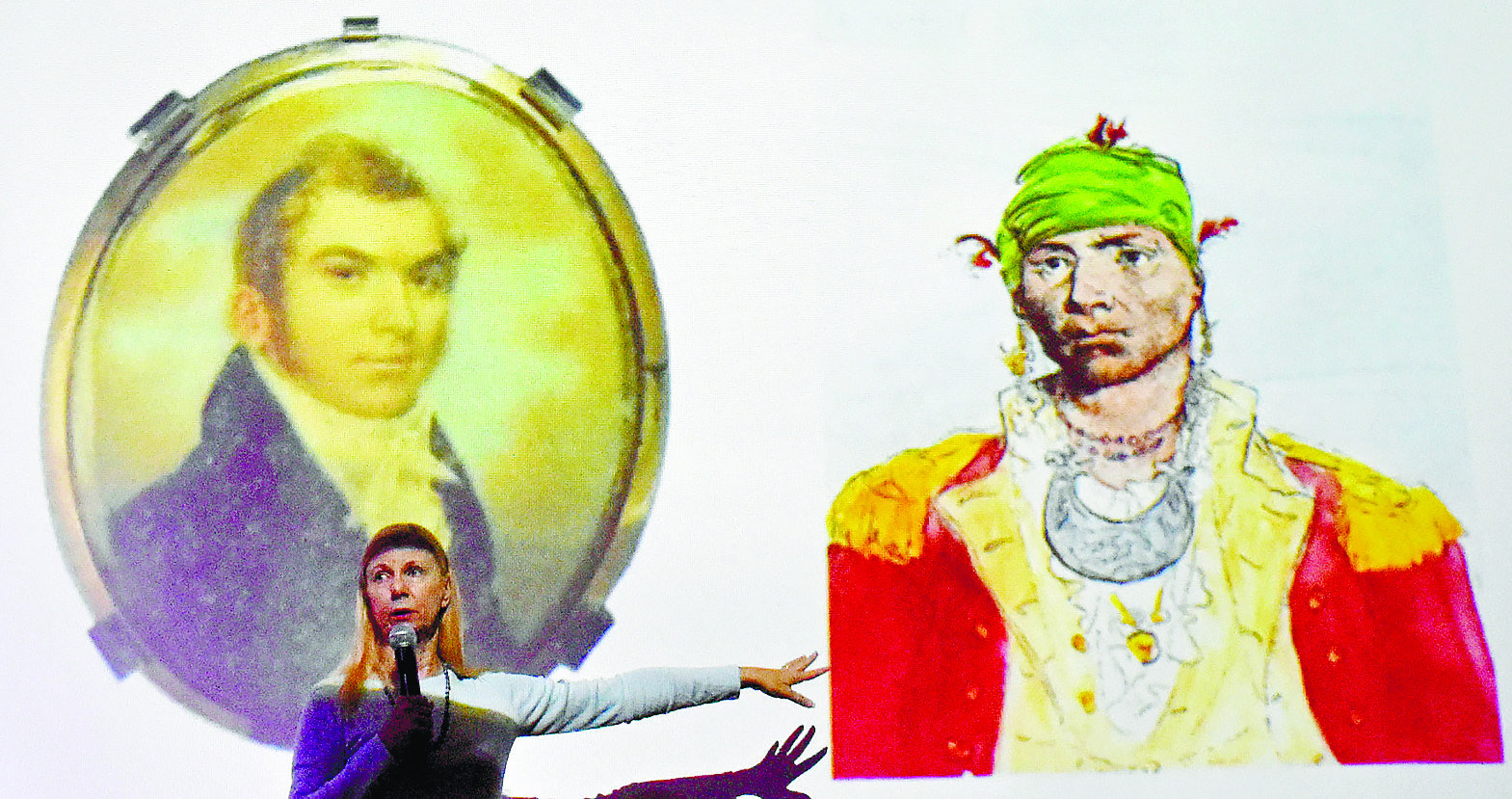
The theatre at The Plaza Arts Center in Eatonton was full on March 5, as the Old School History Museum hosted historian Mauriel Phillips Joslyn speaking on Alexander McGillivray, a half-Scot, half-Creek Indian known as “The Alabama Talleyrand,” as part of its Sunday at the Museum lecture series.
“This is our 10th year to offer the Sunday at Museum lecture series and I am really proud of that,” Old School History Museum Director Sandra Rosseter said.
Rosseter added she initially thought 25 attendees would make it a success, but after 61 people attended the first lecture and 81 showed up to the next, she became convinced it wasn’t “just a fluke.”
“We had people sitting in the grocery store looking out through the screen door for that one,” she said referring to the OSHM replica of a grocery store. “That's when we moved to the reception hall and started having our lectures there.
And now we are in the theater, where seats are far more comfortable.”
Joslyn, formerly an adjunct professor of history at Georgia Military College and currently a GMC special collections archivist, is the author of five non-fiction books, plus a novel named Shenandoah Autumn, and a screenplay for the movie My Christmas Soldier.
According to amazon.com, she has contributed to encyclopedias and several noted history-focused magazines, as well as received Author of the Year honors in 1998 for A Meteor Shining Brightly.
Joslyn told The Plaza audience that McGillivray was nicknamed after the French statesman Charles-Maurice de Talleyrand for exhibiting amazing diplomatic skills and “being a master in beating politicians with their own game.”
McGillivray was a son of Lachlan McGillivray from Scotland and a Creek woman named Sehoy. By age 12, he lived with his mother as was a tradition in Creek families, but he then left the Creek world and moved to live with his father in Charleston, got the finest European education, and became a lawyer. When the Revolutionary War started and his father lost his land, McGillivray returned to the Creek Nation and became a chief.
“The funny thing about Alexander is that he wore a lot of hats,” Joslyn said. “He was an American minister for Spain. He was an American minister for France for a little while. Then he was the minister of the Creek Nation. He had all these uniforms. When he went to talk to the Spanish, he wore a Spanish uniform. When he went to talk to the British, he wore his British uniform. And when he went to talk to George Washington, he wore an American uniform.”
McGillivray also “pushed for more modern ways to govern,” Joslyn said, and being aware of combined power, he changed the traditional village autonomy in an attempt to create a stronger central government to represent the Creek nation.
He also repudiated the Shoulderbone treaty, which, among other terms, included ceding all lands east of the Oconee River to the white man. Joslyn said the post-revolution Creek frontier was near what is now Milledgeville.
In 1790, McGillivray met Washington, who at that point concluded the federal government needed to control Indian affairs, rather than allow states to make individual treaties.
“Everybody found him delightful,” Joslyn said. All the founding fathers were present at a dinner McGillivray attended with Washington and Abigail Adams, wife of then-Vice President John Adams, described McGillivray as “a very fine-looking man, grave and solid, intelligent, very much the gentleman. He was dressed in white men's clothes, not dark-skinned, capable of discussing politics, philosophy, art and literature in several languages.”
Artist John Trumbull was there to paint a portrait of George Washington. He wanted to do McGillivray’s portrait on canvas as well, but after McGillivray refused, Trumbull ended up doing a rough, pen-and-ink sketch of McGillivray wearing an American uniform, just the way he looked when he was at dinner with Washington. “And that's really the only image we have of him other than those before he became the Chief,” Joslyn said.
At just 43 years old, McGillivray died in Pensacola, Fla.
“You really wonder what might have been if he had lived into the 1800s,” Joslyn said. “Maybe Andrew Jackson wouldn't have gotten his way about the Indian Removal Act because he would have established the Creek Nation with Thomas Jefferson; when he became president.”
McGillivray’s son went to Scotland to live with his grandfather and was attending school there but died while still a student.
With no other children, McGillivray led “a short, but amazing life,” Joslyn said.
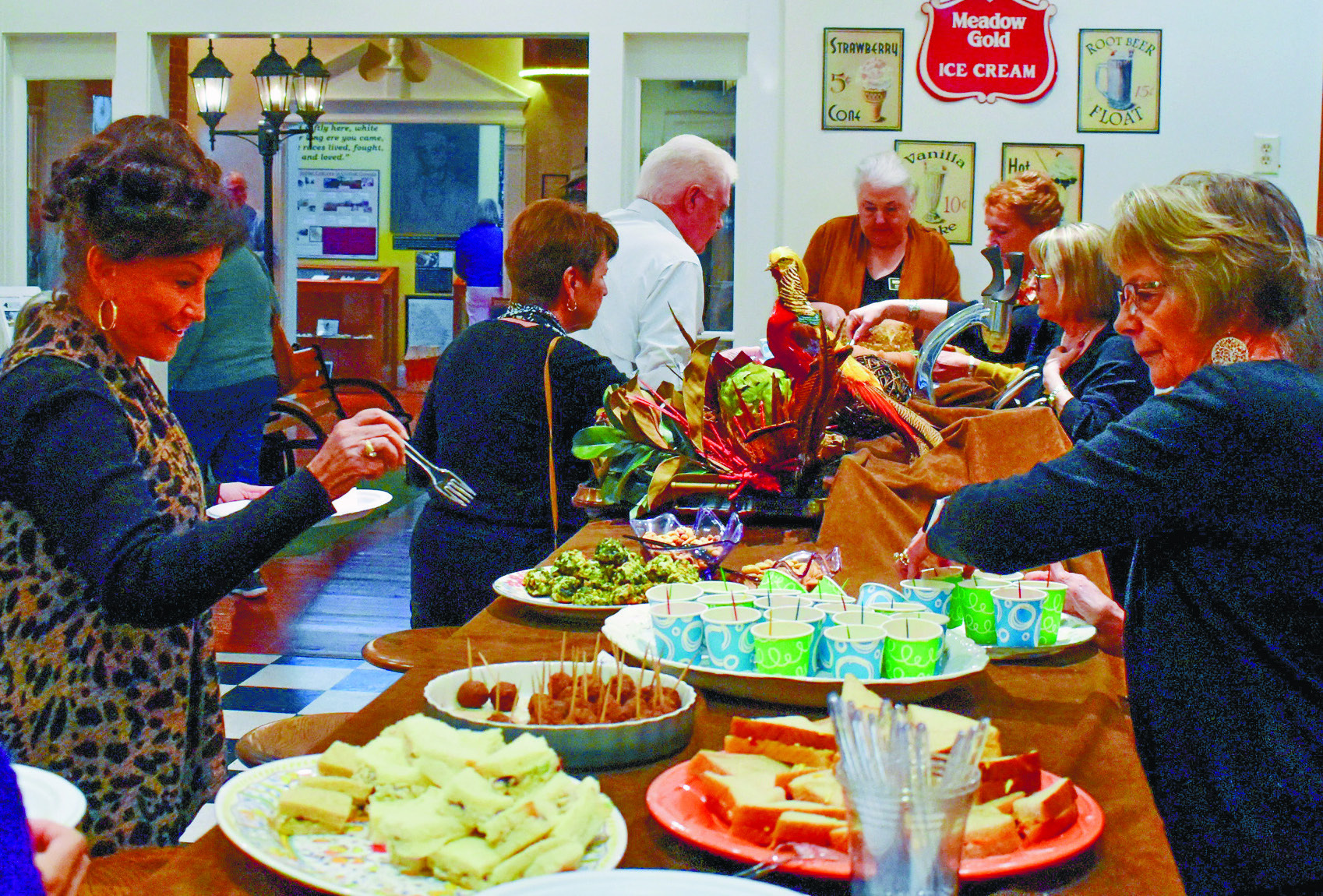
A reception with snacks and refreshments followed the lecture, with Rosseter encouraging guests to sign up for the free, monthly OSHM e-newsletter, which contains stories about the history of Eatonton.
She said the last e-newsletter contained a story about a tree in Eatonton that owned itself and added the stories from e-newsletters can be found at OSHM’s website at oldschoolhistorymuseum.org.