
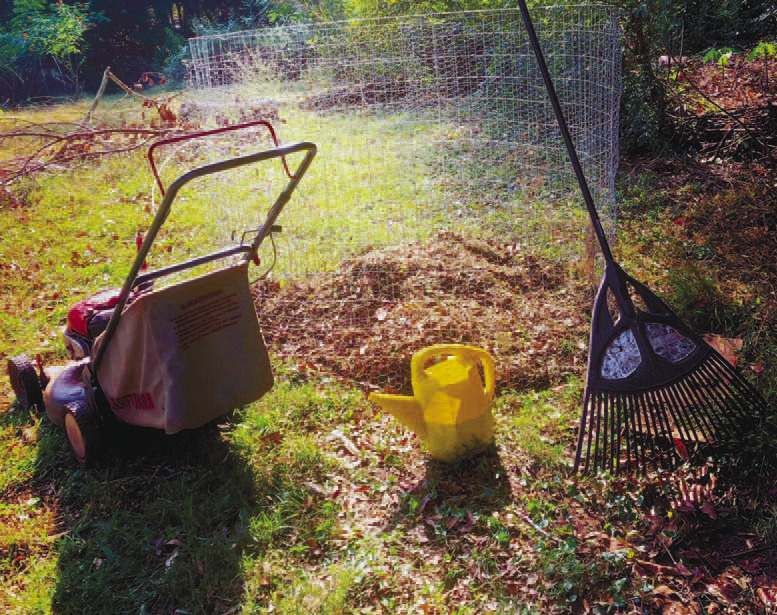
When you have any decent accumulation of leaves that fall upon your property, it is a missed opportunity to generate valuable soil-building material to simply rake or blow them away for disposal.
– Eatonton Gardenerd
Take time for leaf mould
As the struggle to find enough good compost drags on, consider that leaf mould is a weed-seed-free amendment that builds excellent soil structure over time, is bioavailable-carbon rich, and trace-mineral dense.
The process by which it is made is fungally dominated. The leaves fall to the ground, already inoculated with the fungi that breaks them down naturally. When incorporated into your soil it attracts earthworms to your beds, they feed on the partially decayed leaves, leaving castings, which is a free fertilizer injection that you don’t have to manage or administer.
Making leaf mould requires no fancy equipment and can be practically free if you have the gumption to gather and process it. Just a little mower gas and some moisture are really all that’s required. If you are tending fresh three-bin thermophilic composting piles, you are likely already gathering and shredding leaves, so use some for this slow process that doesn’t need tending over the winter.
Scale to Your Space and Fill
A container to hold the mould and allow good airflow through the pile that is at least three feet in diameter and equally as tall is appropriate for a small garden space. If you go smaller than that it can be difficult to keep things moist enough for the fungal activity to flourish.
I most often make mine with common two-by-four-inch welded wire fencing fashioned into a loop, about five feet in diameter and 48 inches tall. When also wrapped with chicken wire the shredded leaves don’t spill out the sides as you fill it.
Use leaves that have been shredded and collected by your standard push mower with a bag, or lacking that, a trash can full of leaves and a weed whacker can approximate the same level of shredding, though in a much more exciting and messy manner.
I prefer the leafy bits to be in the pile instead of stuck in my beard, so I go the mower route. Give it a good soak in the middle as you fill it, a few watering cans in the middle per every foot of height yields good results. Then let it sit. Really. Just walk away and visit again once the soil is warm enough to prepare for planting in the spring.
If you repeat this process and get yourself a dozen of these cages made and filled, you will be amazed at how much material you can generate. If you have space, build it bigger! A simple 8’X8’X4’ square with t-post corners filled to the brim will produce roughly 50 cubic feet of material. This is substantial.
We’ll explore the uses of this fantastic resource come spring.
Until next time, Your Eatonton Gardenerd This week’s jobs: Continue seed-saving – Make leaf mould! – Plant winter lettuce in cold frames Fellow Gardenerds! Send questions, concerns, and tips to: garden. nerd.31024@gmail.com