
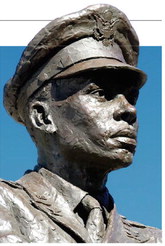
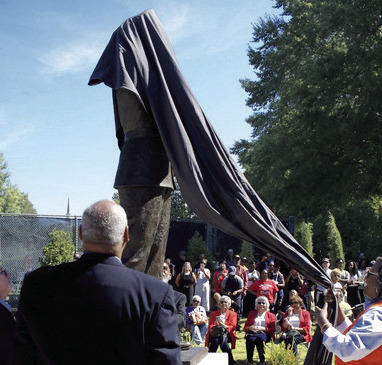

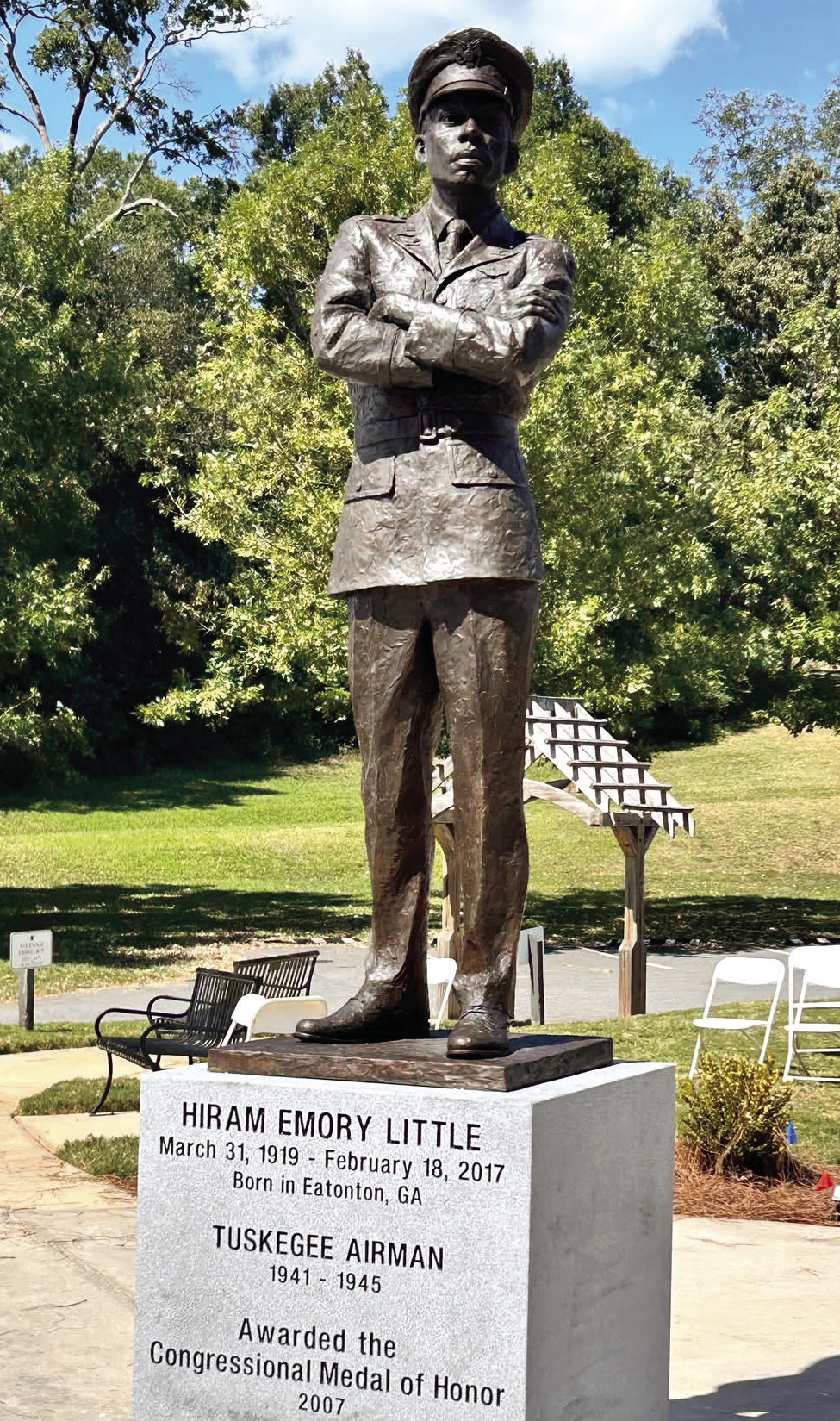
Despite hot, sticky conditions last Wednesday morning at Veterans Wall of Honor Park, the crowd gathered beneath Eatonton’s new statue honoring Tuskegee Airman and native son Hiram Little, showed no hurry to go home. Instead, people lingered beneath the towering bronze figure, posing for photos and selfies, visiting one another, and taking in a tribute more than six years in the making.
Approximately 350 people attended the Sept. 30 dedication alongside West Marion Street to honor an Eatonton native whose service in the U.S. Army Air Forces helped break racial barriers during World War II.
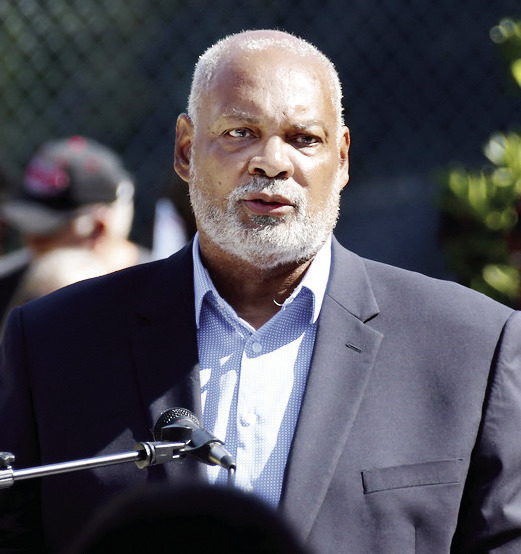
For world-renowned sculptor Basil Watson, the strong community response was the most meaningful part of the day.
“The real value is about opening the mind of the community,” he said. “It is overwhelming to see the support of the community and how they have embraced the story of Hiram and what he represents.”
Watson, an Atlantabased artist whose work includes the famous National Windrush Monument at London’s Waterloo Station, created the nearly 9-foot-tall bronze figure of Little as a young serviceman. The completed monument stands nearly 13 feet, including its solid granite pedestal.
Putnam County District 2 Commissioner Richard Garrett said Watson’s involvement made the monument even more significant.
“I was amazed when Eatonton managed to secure Mr. Watson as the artist,” said Garrett, who remembered the Windrush monument from previously living in England. “We should be extra honored to have that artistic talent behind this statue.”
Garrett also called Little “a really special son of Eatonton” and suggested the ceremony could prove to be significant for the local community.
“I think we’ll look back on this event as a real milestone in city history,” he said.
Little was born March 31, 1919, in Eatonton, and enlisted in the Army Air Forces in 1941 as part of the Tuskegee Aviation program. He later joined the 477th Bombardment Group and became an instructor at Maxwell Field in Alabama, helping to train Black pilots. He also participated in the 1945 Freeman Field protest, when 101 Black soldiers refused an order tied to segregation of the officers’ club there.
Little’s story extended beyond his military service. He later graduated from Morehouse College, became one of the first Black supervisors in the Atlanta postal service, and remained active in civil-rights and community efforts. Alongside several of his Tuskegee Airman peers, Little received the Congressional Gold Medal in March 2007 from President George W. Bush. He died Feb. 18, 2017.
Eatonton Mayor John Reid said the occasion was special to him since he knew Little personally and had honored him at Texas A.M.E. Church over the years.
“He never boasted about the things he did,” Reid said. “You actually had to read about it to actually understand him.”
Reid said the sight of people from different backgrounds gathering for the ceremony demonstrated what Little’s legacy can represent.
“We need to tear down all the barriers that separate us,” he said.
Kevin Tomson-Hooper, among the driving forces behind the monument project, acknowledged becoming emotional during the ceremony after watching the community rally around the finished sculpture.
“It was a sense of togetherness, the community coming together,” Tomson-Hooper said. “Obviously it’s been a six-year journey and seeing it really happening, to me that was just so special.”
Even after the formal program ended, people continued gathering around the statue, including Little’s son, Marshall Little, among several other extended family members.
“Just the number of selfies being taken under the statue here says so much,” Tomson-Hooper said.
Also attending was Reuben Sparks, president of the Tuskegee Chapter of Tuskegee Airmen Inc. and president of the organization’s Central Region, which includes 19 chapters. Sparks said he drove that morning with his grandson from Panama City, Fla., after learning of the event just over a week earlier.
He left feeling “very impressed,” Sparks said.
“The event, the crowd, the statue, the people here, all of this was just so impressive and special,” he added. “It was so worth the trip. I’d do it again in a heartbeat.”
The Hiram Little monument project, costing more than $300,000, was funded through individual, organizational, and community contributions. Putnam County crews prepared and landscaped the site and installed a tall flagpole beside the statue, now flying the Stars and Stripes with a Tuskegee Airmen flag directly below.
For a man whose quiet demeanor sometimes obscured the scope of his accomplishments, it was clear by Wednesday’s gathering that Little’s legacy will remain an important part of Eatonton for decades, and perhaps even centuries to come.