
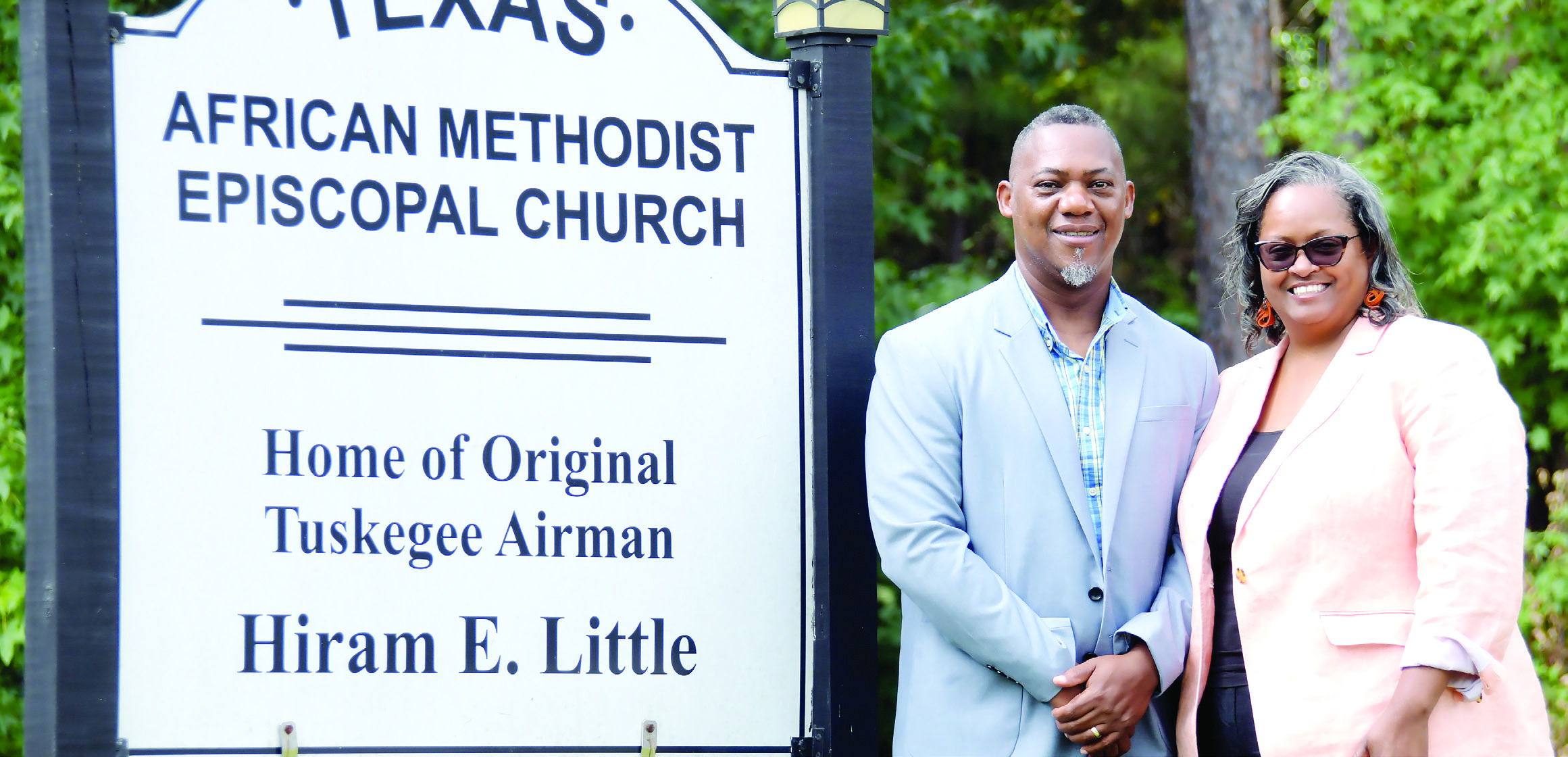
What began more than two decades ago with Simone and Grady Jones wondering why so few people in his hometown knew Hiram Little’s story is about to become a permanent part of downtown Eatonton. An 8-foot-tall bronze statue atop a 4-foot granite base will soon commemorate Little, a Putnam County native and a member of the world-famous Tuskegee Airmen during World War II. It’s scheduled to be unveiled and dedicated at 11 a.m. next Wednesday at the county’s Veterans Wall of Honor Park.
For the Joneses, who were instrumental in developing and following through on the statue project, the quickly approaching dedication has made a years-long effort suddenly feel very real.
“To me, that’s the power of a thought,” said Grady Jones, who operates a popular barber shop just a few hundred feet from the statue site. “It all started just as a thought, an idea that turned into a conversation, and that conversation turned into action, and now action has turned into reality.”
The couple’s connection to Little began 22 years ago, when Simone Jones became pastor of Texas AME Church near the eastern end of Putnam County. When church members told her about a Hiram Little Day planned as part of February’s Black History Month shortly after her installation, Simone’s first question was obvious: Who was Hiram Little?
Researching that question changed everything for the couple.
Simone Jones discovered the quiet man connected to her congregation had been part of an extraordinary chapter of American history as a member of the famed Tuskegee Airmen during World War II. Yet, when she and her husband began asking people around Eatonton if they knew Little, they frequently received the same response: “Who?”
That inspired the couple to begin looking for ways to publicize Little’s service and legacy. Simone Jones began expanding Hiram Little Day beyond a church observance into a community event.
One year it was held at Eatonton’s historic The Plaza Arts Center and included Buffalo Soldiers, representing all-Black U.S. Army regiments. Another recognition involved purchasing and naming a seat at The Plaza in Little’s honor, while yet another saw a flag dedicated to him. Before he died in 2017, Little even participated at some events, occasionally with other original Tuskegee Airmen.
Eventually, though, Simone Jones realized Little preferred smaller celebrations.
“He did enjoy getting some recognition from his hometown,” she said, but remained “very humble and not very comfortable” with wider public acclaim.
Still, the idea of creating a permanent statue recognizing Eatonton’s own Tuskegee Airman persisted. The decision to go forward came years later amid national debates over monuments and which figures communities should choose to commemorate. Simone Jones recalled suggesting that rather than simply removing monuments that others appreciated, communities could broaden the history represented by adding alternatives.
“Just put up one to balance it,” she recalled saying of the Confederate monument erected opposite the county courthouse in 1908 and still standing. “Put Hiram up there; he’s from Eatonton,” she added.
To help promote the idea, about six years ago the Joneses approached Kevin Tomson-Hooper of The Artisans Village, who accepted most of the fundraising and organizational challenge to turn the idea into reality. Tomson-Hooper brought together community supporters and donors, county government, and finally the substantial investment needed for renowned Atlanta-based sculptor Basil Watson to create and install the statue.
Veterans Wall of Honor Park ultimately became the selected location, giving visitors room to park, walk the grounds, and spend time at the monument. The county also agreed to maintain the site, Tomson-Hooper said.
For Simone and Grady Jones, however, Sept. 30 represents something more personal than completing a public art project. They knew Little, listened to his stories, researched his past, and spent years trying to convince others that someone important, someone historically significant, had been living quietly among them for decades.
“He’s a big deal,” she recalled telling even members of Little’s family. “He’s Black history; you’re Black history; you’re living history.”
Now, with the statue nearly ready to take its permanent place, she believes the recognition would have deeply touched Little.
“I’m excited. It’s a historic moment for me,” she said. “Knowing Hiram, he would be so honored. So, it’s emotional for me because I know how much this meant to him.”
The approaching dedication hits Grady Jones just as hard. When he learned Sept. 30 was confirmed as the installation and dedication date, he said the news brought him to tears.
“It was like a chill just went over my body,” he said. “But it was of joy.”