
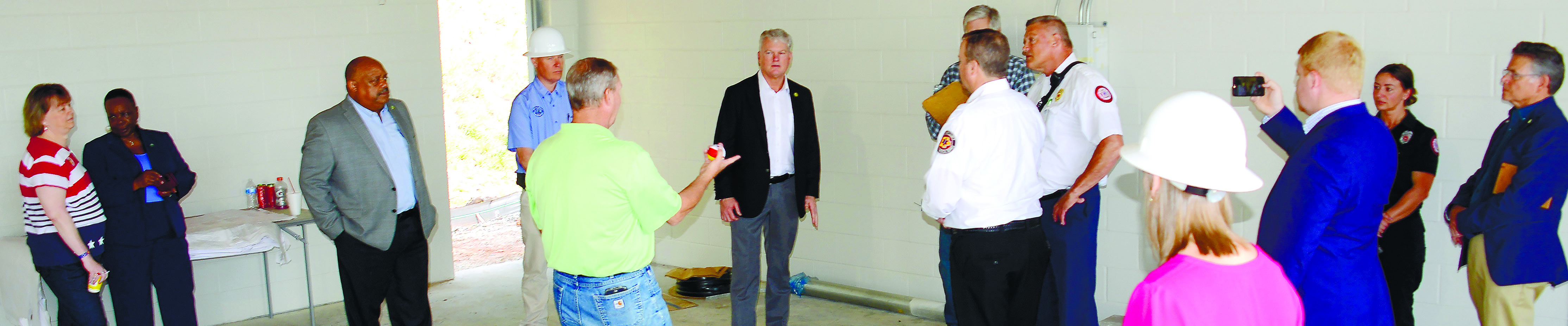

Old-school politics were on full display April 6 in Putnam County. A tour of a new building under construction. Public visibility and handshaking.
An hour-long confab with local officials featuring needs and wants, frustrations and worries, and, of course, money – responded to with blunt stances and few details.
As a newly elected congressman in a newly reconfigured 10th Congressional District, Republican Mike Collins of Butts County came here as part of a “listening” tour of the 19 mainly rural counties and parts of five more suburban/urban counties within his district. The 10th District basically runs east-west between east-Atlanta suburbs to Augusta and north-south between Clarke and Johnson counties.
The visit began with an informal tour of Putnam County’s new fire station/ emergency services complex currently under construction behind the county administration building off U.S. 441.
The walking chit-chat leaned more toward who got which business contracts than the source of funding (mostly the 2021 American Rescue Plan Act, a Democratic program).
The congressional visit coincided with “Fun Day” displays and games for county employees and their children, and also a politician’s staple “press the flesh” opportunity for visibility, with smiles and handshakes all around.
At one point, Collins and a four-month-old together petted a very sleepy and gentle Putnam County Animal Shelter dog. But he didn’t kiss any babies.
There followed a more serious session inside, listening to Putnam’s commissioners and Eatonton’s council members about their needs, wants and concerns related to the federal government. Comments leaned more heavily toward the intricacies of federal money and regulations and less on culture war issues fought on nightly cable news shows.
Collins’ responses afterward leaned more heavily on his sometimes-blunt attitudes and approaches and, given the time available, less on detailed answers.
Some examples: Putnam County Sheriff Howard Sills: “I have no complaint about my job from the federal agencies we work with … but if you want to talk about the state, I’ve got two or three bushels.”
Putnam Development Authority Director Matt Poyner: “It is hard for rural counties to compete with urban counties for industries. They have the money, and they have the land.”
Commission Chairman Bill Sharp mentioned three topics: One, infrastructure in rural counties, specifically for water and sewer expansions (to which Mayor John Reid would add, “We’re playing catch-up.”). Two, the cost of medications, citing his own recent hospitalization where just two medications cost $2,200. “I am concerned about people who can’t afford something like that, having to choose between food or medications,” Sharp said. And three, “The scuttlebutt that would have the inheritance tax exclusion of $10 million back to $100,000.”
Collins would later reply only to Sharp’s third concern. “That’s double taxation. You’ve already paid it once.”
Eatonton Mayor John Reid (in addition to his comment on infrastructure needs, like replacing 50-year-old water lines): asked Collins to protect natural gas production, given the city’s investment in its gas department over the years.
County Manager Paul Van Haute: brought up unreimbursed ambulance bills and the long lead times required to buy new equipment and vehicles for first responders.
Commissioner Daniel Brown: reminded Collins of the financial struggles of rural hospitals and help for people who can’t pay. He also asked Collins to “do whatever you can to continue the HEART (tax) program.”
Commissioner Jeff Wooten, a retired dairyman: “Look out for the farmers” as we start to import food, even if we have to impose tariffs as some other countries do. There is one thing we’ve got to have and that’s food. And we can produce it.”
Wooten said the younger generation does not want to go through all the hassles from agencies like the Environmental Protection Agency and see land prices as an opportunity to sell rather than to buy.
Meanwhile, Collins is no stranger to dinner-table discussions of party politics, nor to public debates and backroom bargainings. His father, Mac Collins, served in Congress for 12 years, having been part of Newt Gingrich’s first Republican House majority in 50 years (1994).
As Collins himself built a 150-unit trucking company, he remained active in state Republican politics. And now that he’s in Congress, he sees the biggest differences from Washington of 30 years ago as the “palpable” divisiveness. “We used to stick together,” he said, though it is unclear who “we” exactly refers to, and bemoaned the role of instant policy positions put out through social media.
In response to some of the local concerns, Collins led with his assignments to three committees: Trade and Infrastructure, Natural Resources (where he serves as vice chair of the oversight subcommittee), and the new Space, Science, and Research (where, as a three-month freshman, he chairs the subcommittee on research). “Yeah, UGA is excited,” he joked.
In other comments, Collins noted that 85 percent of the drugs we have are manufactured in China (“That scares me.”) and said that despite earlier reports to the contrary, Medicare and Medicaid benefits would remain safe, though adding, “Republicans will always look for ways to cut costs.”