
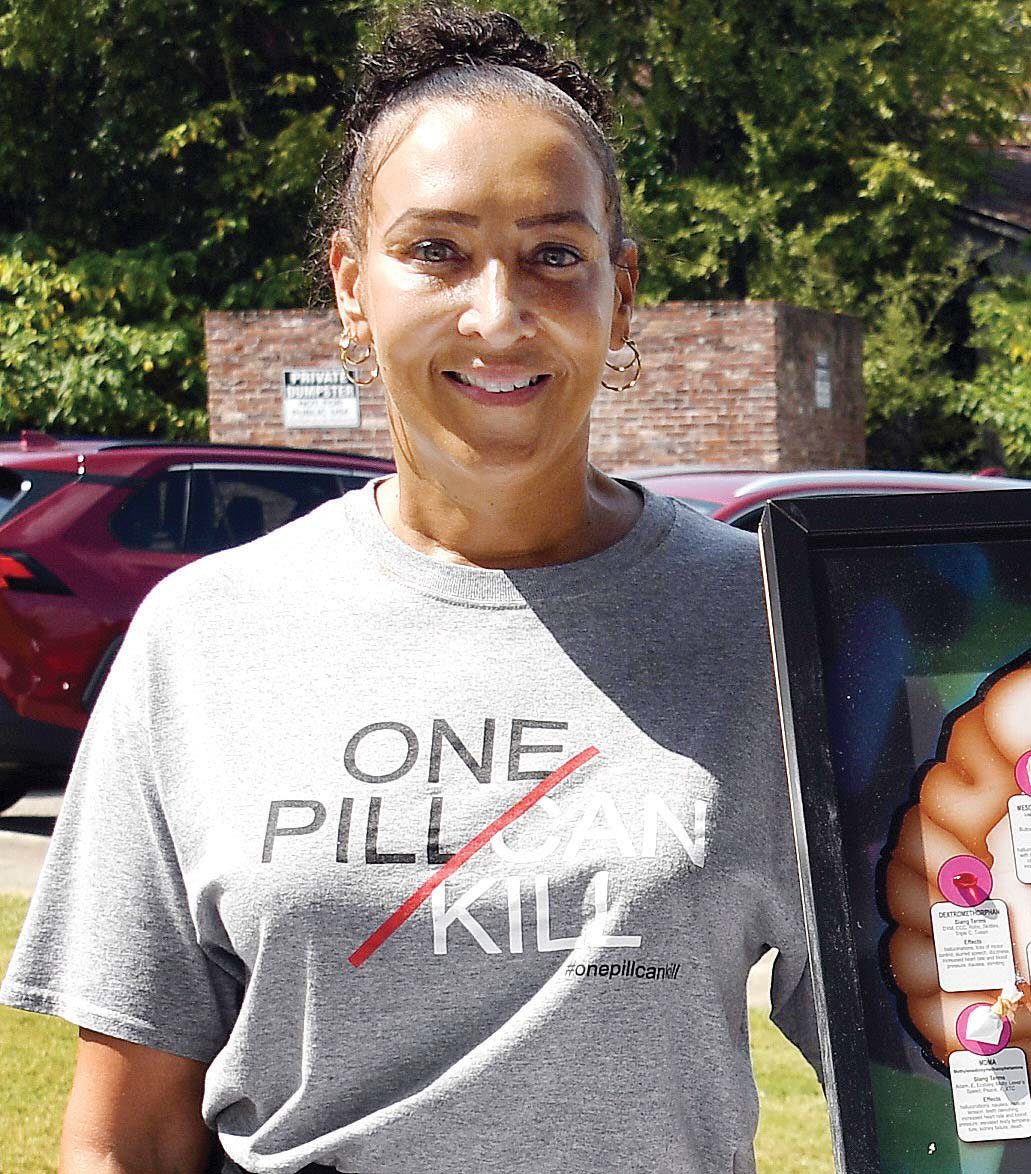
When Wanda Wiggins meets with students, parents, or community groups, she doesn’t come to lecture.
She arrives with a warning.
“My mission is to serve the community, getting the knowledge out there about ‘One pill can kill,’” said Wiggins, a community outreach specialist with the U.S. Drug Enforcement Administration (DEA). “It only takes two milligrams of fentanyl to end a life.”
Based in Atlanta, Wiggins covers Georgia, South Carolina, and North Carolina, frequently traveling when schools, local governments, or nonprofits request assistance. Her goal is to put life-saving information in front of the public, but especially in front of young people who may not realize how dangerous fake prescription pills can be.
She was in Eatonton on Saturday, participating in an opioid awareness event presented by Beyond the Bell at City Center Stage.
Wiggins said fentanyl, a synthetic opioid developed initially as a powerful painkiller, has become the leading driver of America’s overdose epidemic. But unlike tightly regulated versions prescribed by doctors to treat cancer and severe pain, most fentanyl found on the streets is illicitly manufactured.
“The precursor chemicals to make the street fentanyl are coming in from China, straight down to Mexico, and then across the border,” Wiggins said.
Ironically, she added, “But drug dealers aren’t out to kill people; they’re out to make a business profit by getting people addicted.”
The only way to avoid the danger, she continued, is to avoid taking illicit drugs that may be dosed with fentanyl because it makes the “host” drug more addictive. However, the problem stems from the way the drug is mixed, she added. To illustrate, Wiggins said she often uses a kitchen metaphor with high school students.
“Think about making a bowl of chocolate chip cookies,” she said. “Each cookie isn’t going to have the same number of chips, and that’s how fentanyl pills are made. Dealers dump in chemicals, press them into pills, and you don’t know how much fentanyl is in each one. One pill might not even affect you; the next might kill you.”
According to Wiggins and the DEA, the statistics are scary, with five out of 10 fentanyl-laced pills seized from the streets containing a potentially lethal dose. Nationwide, more than 265 people die every day from overdoses, she added, with many linked to fentanyl. That adds up to nearly 97,000 deaths per year.
“It’s Russian roulette,” Wiggins said. “You may get one pill under two milligrams and nothing bad happens, but then, you may get a pill with more and you die. The thing is, if you survive a few times, you start to feel comfortable. But every time, the next pill could be the last.”
Fentanyl is frequently mixed into drugs like cocaine, heroin, methamphetamine, or counterfeit opioid pills sold online or on the street. Because the powder is colorless and odorless, users have no way of knowing if what they’re taking is contaminated.
“You cannot see it, smell it, or taste it, and that’s what makes it so dangerous,” Wiggins said.
Treatment options do exist, though entering recovery is a personal decision.
“Usually when I come out, we have community partners there, too,” she explained. “Mental health departments, public health officials, they can connect people with resources if someone wants to get help.”
In emergencies, Wiggins stresses the importance of naloxone, commonly known by its trade name, Narcan. The medication can reverse opioid overdoses if administered quickly.
“Our community health partners train people on how to use it,” she said. “It literally breaks the fentanyl receptors in the brain apart.”
For Wiggins, the solution stems from awareness. “Please, go to dea.gov whenever you want facts. Do not rely on what someone tells you on the street,” she stressed. “At least get the truth and know what you’re dealing with.”
As the fentanyl crisis deepens, Wiggins’ message remains urgent and simple: every pill bought outside a pharmacy could be a fatal gamble.
“We don’t like to say no when communities ask for help,” Wiggins said. “Because the more people know, the more lives we know we can save.”