
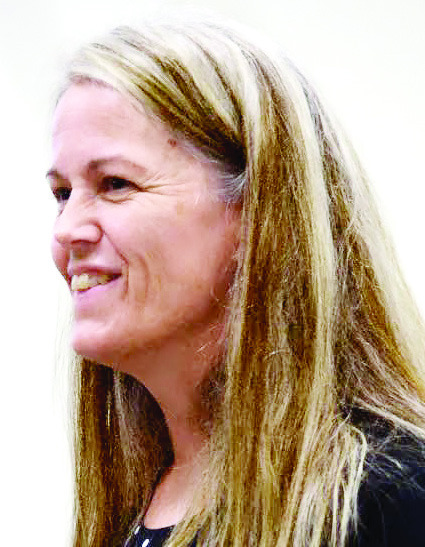
“I do not like public speaking, so please give me a minute to get used to being up here,” Putnam County Elections Supervisor Kim Rudolph freely admitted to the county commission on June 7 during its regularly scheduled meeting.
Rudolph was called in to address the legislative void left by the recent passing of Putnam County District 1 Commissioner Gary McElhenney. Beyond the natural aversion to speechmaking so many have, Rudolph recognized her word choice and explanations were vitally important and open to scrutiny and interpretation given the current level of public interest in election protocols.
She pointed out county legal counsel Adam Nelson called the sudden need for an election “a super special situation” since McElhenney’s seat appeared to be locked up for about the next four-and-a-half years.
“Mr. McElhenney was the current commissioner and then the only one that ran in his primary and was going to be the only one representing in November,” Rudolph pointed out. “So that gives us the optic that his term went all the way for the next five years, through the rest of this one, and then all the way through until 2028.
“What is the truth is we are actually looking at two very separate terms. So, if we can take the time to separate, we are dealing in a current term that is now vacant and then subsequently a second and separate term.”
She then explained the state dictates what times and dates the county can hold elections, both in odd-number years and even-number years. So, since 2024 is a number year, by law, November presents the next available date for a local election.
“When we have a vacancy in our current term, because the vacancy is outside of six months, we actually have to hold a special election to fill that vacancy,” Rudolph said. “So, the next opportunity for us to do that based on state law is going to be in November … so, for our current term, we will hold a special election; it will be on the ballot with the presidential election.”
Though that election is open to nonpartisan or partisan candidates, Rudolph said it’s run as a nonpartisan election, so both parties and even write-in candidates can enter to run on that ballot, which will fulfill McElhenney’s term as it sits today, until Dec. 31, 2024.
She added, however, that a potential extension to that date exists as well regarding the second term.
“So, when we are dealing with the next term, which was supposed to start Jan. 1 for Commissioner McElhenney, since he was the only one who primaried back in May this last election, he was the only one who qualified. There was no opposition in his own primary and then there was no opposition against him come November from either an independent or the Democratic Party. And because of that, we have a very special state law which is 21-2-134D, which states that we are now to hold a special primary,” Rudolph told the commission.
“The primary is only available for the party of the deceased that won the primary. So, we’re looking at the next opportunity we have to hold an election in November [and] we’ll now also be holding a special primary in November to replace Mr. McElhenney as the candidate for the Republican Party. And we’ll only be able to hold that open to Republicans, based on state law,” she continued.
“So, with that being said, what would’ve normally been our election in November for the next term is now going to be pushed since we have to hold a (Republican) primary in November; that next election will be pushed to March of next year. That is the next open availability to hold an election. So yes, it has been very complicated.”
With the vacancy established within the current term, though, Rudolph said an election would be called for “sometime between 30 and 60 days after the vacancy,” according to code section 36-5-21.
Rudolph said that the qualification fee for that election is currently estimated to be $252, although qualification dates have not yet been established.
“They have to be within 25 days of the election, but we are going to do it well in advance of that, looking at potentially early September,” she said, explaining the Board of Elections will hold a meeting to discuss and vote on whatever issues arise.
“Then we will also announce qualification fees and a timeline open to any candidates for that particular race that will go on the November ballot. It will be part of the special elections that they’ll see after our normal stuff, presidential and house and all of that, as well as other special elections that the county is required to hold or asking to hold. So that will be November separately.
“Apart from that – and this is where I don’t want the voters to get confused –we will have to hold a separate election on the same day. So, we’ll be using different machines. We will be as organized as we can to help people understand it will not be open to the whole county. It will be only open to those that live in District 1, and you might see on Election Day it will affect us here at (polling station) 101, and it will affect 104 and 105.”
Rudolph said there is “plenty enough space” at each polling place to create a separate section for the special District 1 commissioner election, but the challenge will remain in ensuring that all voters understand whether they qualify to vote in that race.
“That will be on us to train the poll workers to help people understand that when they’re checking in for their November ballot that, ‘Yes, they do qualify to vote in the primary and then subsequently can come back around and do so; or no, they do not (qualify for the primary), and they’ll just only cast their ballot for November. So that is what we’re looking at in needing to hold a special primary,” she explained.
“We’ll do everything we can to help the voters understand with signage and maybe even colors, just exactly what they’re looking at. But I do want to do whatever I can to communicate to the voters that this will be separate and apart,” she stressed to the county commission. “It cannot go on the same ballot. Subsequently, part of election law also still holds space for a write-in candidate on what would have been our November election for District 1, which has now been pushed out to March.
"There is still time in Georgia law for write-in candidates that needs to be, if anyone chooses to do so, the write-in candidate has to publish within the legal organ (The Eatonton Messenger) by September 3rd of this year if somebody so chooses,” Rudolph continued.
So, she added, the potential exists for someone to run against whoever wins the Republican primary.
“If no one writes in to run against whoever primaried or won the primary in November, then we would actually be able to start the term of whoever wins the Republican primary January 1st. However, if we do have a write-in candidate, we will have to hold a March election,” Rudolph said.
She added that there remain “some moving parts” and that timelines may continue changing based on various factors.