
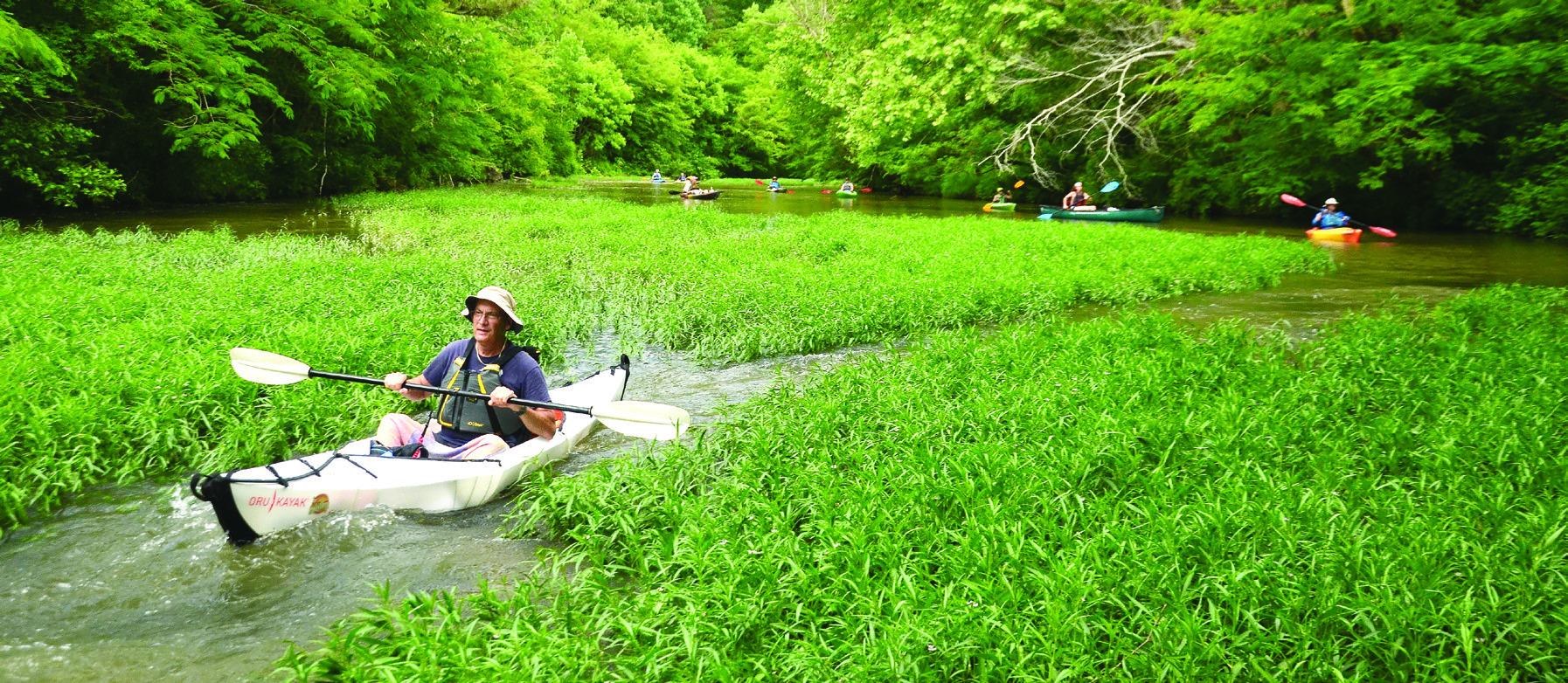
A bill currently in play in the legislature seeks to clarify boating, fishing, and hunting rights on the state’s large navigable streams like the Altamaha and Savannah but leaves hundreds of miles of smaller streams that are popular boating destinations at risk of being closed to the public.
Representatives with Georgia River Network, Georgia Canoeing Association, American Whitewater and American Canoe Association, as well as private citizens and outfitter businesses, are currently fighting to retain and confirm Georgians’ “right to float” on the state’s many small rivers and streams.
House Bill 1172, which cleared the House Judiciary Committee early this month by just one vote, is a follow-up to legislation the General Assembly passed on the last day of last year’s session. Last year’s bill was introduced following a lawsuit a property owner along the Upper Flint River filed seeking to ban public fishing along his stretch of the river.
After Gov. Brian Kemp signed the bill and it became law last July, some waterfront property owners expressed concerns that the measure included language codifying Georgia citizens’ right to use the state’s waterways under the “public trust doctrine.”
The new bill struck the reference to the public trust doctrine while maintaining the purpose of last year’s legislation, House Majority Whip James Burchett, R-Waycross, House Bill 1172’s chief sponsor, told committee members before Thursday’s vote.
“By common law, the citizens of this state have the inherent right of use for passage for hunting and fishing on navigable streams,” he said.
Burchett emphasized that the bill only applies to navigable streams.
However, the measure’s opponents argue the current definition of “navigable streams” in state law dates back to the 19th century, a time when Georgia’s waterways were used to transport freight.
Joe Cook, coordinator of the Georgia River Network’s Paddle Georgia program, said that definition leaves out many streams across the state that are capable of floating a boat.
“Vast numbers of Georgia streams will fall under the category of non-navigable,” he said. “Many of our trips take place on rivers and streams that may not be deemed navigable. ... There is a right of passage on all these streams that are not navigable.”
Suzanne Welander, author of a Georgia canoeing and kayaking guidebook, said recreational paddling is a fast-growing activity in Georgia that generated $1.1 billion in revenue in 2022 and is responsible for 238,000 jobs.
“I’m concerned future generations might lose this ability to have those experiences,” she said.
Carol Reiser, past president of the Georgia Canoeing Association, said lawmakers in North Carolina and South Carolina have passed fishing rights legislation that guarantees public access to any river and stream that can float a boat, as long as the boaters don’t get out of the water and enter private property. She suggested recreational canoeists in Georgia would welcome a similar approach.
“We pass through,” Reiser said. “We don’t get out and party on people’s property.”
However, representatives of the Georgia Farm Bureau, the Georgia Forestry Association, and the Georgia Agribusiness Council told the committee they support Burchett’s bill in its current form.
Committee Chairman Stan Gunter, R-Blairsville, who cast the deciding vote to approve the bill, suggested it could be subject to some changes as its moves through the House.
“This is just the first step,” Gunter said following the vote. “There’s more to go.”
House Bill 1172 now heads to the House Rules Committee to schedule a vote of the full House.