
Legend doesn’t just happen; it’s forged in the moments when most folks are looking for the exit.
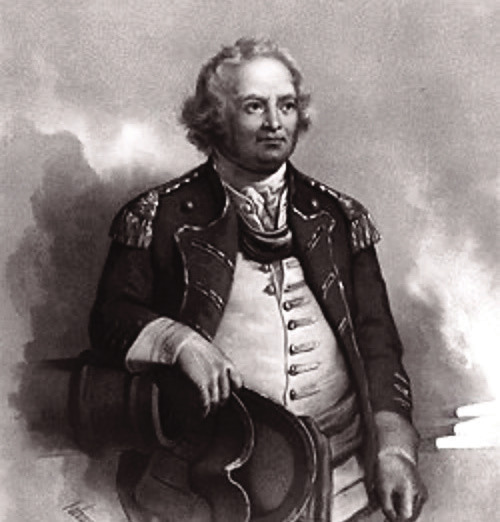
Israel Putnam — “Old Put” to those who would eventually follow him into the fire of the American Revolution — wasn’t a man of polish or pedigree. He was a man of grit, directness, and a brand of courage that felt less like bravado and more like a simple refusal to back down.
In the world of leadership, we often hear talk about “getting in the trenches.”
Putnam didn’t need the metaphor. He lived the reality.
The year was 1742, long before shots were fired at Bunker Hill. A large marauding wolf had been terrorizing the flocks of sheep in Pomfret, CT, creating not just a nuisance, but a threat to the community’s livelihood.
After a grueling all-night hunt, locals tracked the beast to a deep, narrow cavern. The dogs retreated, whimpering. Everyone refused to enter the cavern. And the smoke of burning straw failed to drive out the wolf.
While the crowd stood frozen by the “what-ifs,” Israel Putnam stripped off his coat, tied a rope around his ankles, and grabbed a torch and a musket. He didn’t delegate the danger. He crawled into the blackness on his hands and knees.
The first time he entered, the torchlight revealed the predator’s glowing eyes and bared teeth. Putnam kicked the rope, was hauled out, then went back in immediately. That second time, he fired. He was pulled out through the dirt and rocks, a cloud of gun smoke following him.
He then entered the cave a third and final time, just to haul the beast out by its ears.
Putnam knew you can’t inspire a community from the safety of its perimeter.
You must go forth into the wolf’s den. Whether it was that cave, or later commanding his troops “not to fire until you see the whites of their eyes,” Old Put’s leadership was built on a foundation of shared risk.
It was the kind of leadership that helped nurture a young democracy into maturity and stability.
Putnam wasn’t a man of complex theories; he was a man of authentic action.
He understood that trust isn’t a byproduct of a title; it’s the result of being the first one into the dark and the last one out.
On Dec. 10, 1807, the Georgia General Assembly formed a new county from land originally part of Baldwin County, naming it Putnam after American Revolutionary War General Israel Putnam.
So, the next time you find yourself saying, “I’m from Putnam County,” you will know its legacy.
To learn more stories like this one, don’t miss the Smithsonian Institution’s Voices and Votes exhibit hosted by Georgia Writers Museum and the Old School History Museum, April 25 to May 31, to be housed at the Putnam County Government Center.