
Four years ago, on Oct. 1, Beyond the Bell (BTB) began providing substance abuse prevention programs and services in Macon-Bibb County to combat the early use of tobacco, alcohol, marijuana, and other drugs by youth and young adults.
Concentrating on education for prevention, its programs traditionally have been funded by the Georgia Department of Behavioral Health and Developmental Disabilities.
This summer, BTB expanded its presence in Eatonton with a four-event monthly schedule, starting with a late-June presentation featuring several city officials, politicians, local law enforcement, and state-level legal representatives. That meeting in the county courthouse essentially defined the growing problem of opioid abuse and fentanyl-laced drugs throughout Putnam County, reportedly among the worst 10 of Georgia’s 159 counties for the problem.
Education-focused events at God of Peace Ministries and Jimmy Davis Park followed, culminating in the fourth and final BTB event on Sept. 20 at City Center Stage.
Though attendance was somewhat disappointing overall, Putnam County’s first opioid awareness campaign at least started conversations about addiction and prevention, as well as distributed free, potentially lifesaving nasal spray doses of Narcan, the opioid overdose-reversing drug. Still, community leaders acknowledged that more work is needed to reach families, schools, and local officials.
The final event drew the strongest turnout, though still only 49 people signed in at City Center Stage, which featured information tables and offered training to administer Narcan to overdosing drug users. For many residents, it was their first exposure to the lifesaving medication.
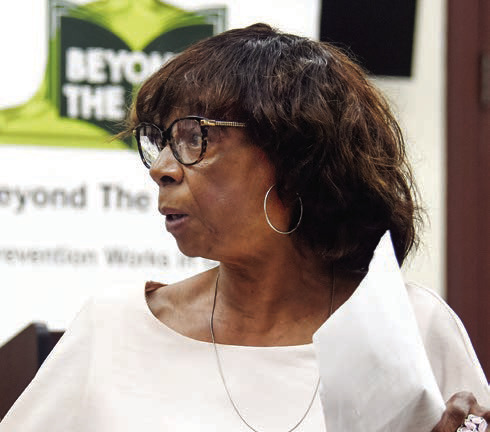
“This was never just about one event,” Beyond the Bell Executive Director Sandra Dean said during a wrap-up meeting Sept. 23 at Sips 31024 in downtown Eatonton. “It was about starting a conversation in Putnam County, and I believe we did that. But the conversation has to continue."
“And we want this to be open and brutally honest because we need to assess what we did, what we could have done, and what we didn’t do,” she added.
Through honest, forthright dialogues, city leaders dissected the BTB program: attendance was limited, schools were largely absent, and county officials essentially skipped the program altogether.
“We got support from some, but not enough,” said Wanda Wiggins, a former detective and now a Rockdale County private investigator and opioid abuse activist who attended the program evaluation. “The message didn’t always reach the people who most needed to hear it.”
The group also acknowledged a somewhat ineffective outreach. Flyers, word-of-mouth announcements, and Facebook posts were made, but little was done through TikTok, X, Instagram, or other social media platforms more popular with young people.
Funding was another concern. The state’s $16,000 grant covered events and a website, but some, most forcefully, Wiggins, suggested the BTB website is too basic to attract much-needed supplemental donors or corporate sponsors. She told the website needed a makeover, stressing the importance of developing partnerships with major companies that want to be good corporate citizens by funding anti-drug efforts.
Law enforcement also raised coordination issues. Eatonton Police Chief Howell Cardwell said local cases are often handed off to state agencies, leaving Putnam officers out of the loop. “We need better communication, not silos,” he said.
Ultimately, the group agreed that Beyond the Bell should apply for a new opioid grant, though Dean admitted she wasn’t confident the county would be funded twice. She added, however, that BTB is also exploring an available afterschool grant to reach more local students and other young people.
Future outreach could include bounce houses, fire trucks on site, and other family draws to boost turnout and reach young parents as well as students, with new online content specifically designed to educate teens. Dean said the Putnam County Charter School System will be a key focus for any future efforts, and she hopes to meet soon with PCCSS Superintendent Derick Austin.
Overdoses are climbing across Georgia, and fentanyl is increasingly present in counterfeit pills and common street drugs like marijuana. Dean warned that the danger should not be underestimated.
“Just because we don’t see it every day on Main Street doesn’t mean it isn’t here,” she said. “And fentanyl is one of the most dangerous things anyone can come across. One time can be too much; it can be the last time.”
Still, the meeting closed with cautious optimism.
“A lot of people think this is an Atlanta or Macon problem,” Eatonton Mayor John Reid pointed out. “But opioids and fentanyl don’t stop at the county line. The more our community understands that, the better prepared we’ll be.”