
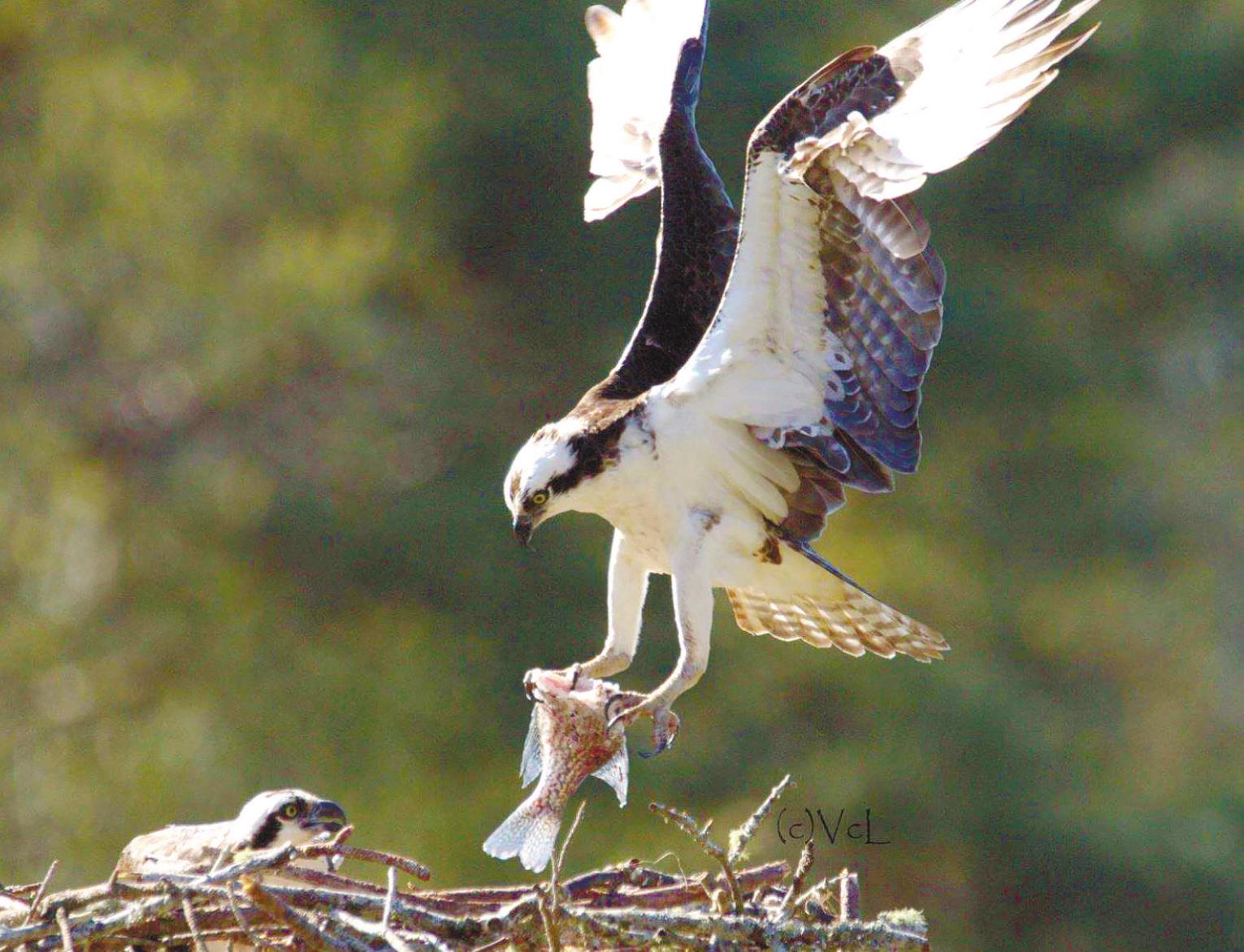
Residents in northeastern Putnam County were briefly without power Saturday morning when an osprey nest caught fire atop a Tri-County EMC utility pole.
Putnam County Fire Chief Tommy McClain said the call came in around 6:15 a.m. July 9, and two firefighters responded.
“All we can do in such cases is call Tri-County EMC and stand guard and watch over the scene until the linemen get there,” he explained, saying it took about 30 minutes for the EMC workers to arrive.
Putnam County Sheriff Howard Sills said the 911 center at his office received the call and they also were notified of the power outage.
McClain said he had not heard of such a fire before Saturday.
“But I can see how it would happen,” he noted. “Their nest must’ve crossed one of the wires and got hot. And we seem to be getting more and more ospreys around here, so it was bound to happen.”
Ospreys are one of the larger birds of prey, according to the National Wildlife Federation. With a wingspan of 21-23 inches, they are smaller than a bald eagle but larger and longer-winged than a red-tailed hawk. With a diet almost exclusively of live fish, ospreys are common sights near open waters. Their nests appear to be an untidy pile of sticks perched in treetops or utility poles along the shores of lakes.
They require nest sites in open surroundings for easy approach, and a spot that is difficult to reach by ground predators such as raccoons. Their nests must be within 12 miles of an adequate supply of fish, according to AllAboutBirds.org, and are common sights around lakes, rivers and oceans all across North America.
Usually, the male finds the site before the female arrives. The stick nests are lined with bark, sod, grasses, vines, or algae. To help prevent Osprey chick deaths, cut up improperly discarded plastic fishing line and baling twin as chicks can become entangled in it if it’s incorporated into the nest, according to nestwatch.org. The male fetches the nesting material and the female arranges it. The couple returns to the same nesting site year after year, each time adding onto the size of the nest.
The female lays one to four eggs, which incubate for 36-42 days. The eggs do not all hatch at once, according to AllAboutBirds.org. The first chick emerges up to five days before the last one, and the oldest hatchling dominates its younger siblings and monopolizes the food brought by the parents.
Nests are seen atop several utility poles around lakes Oconee and Sinclair as well as on small platforms built exclusively for that purpose. It has been noted that some newer utility poles have some type of rod or pointed cone on top, presumably to discourage nesting.
Kim Broun, spokesperson for Tri-County EMC, said they are aware of several osprey nests in the area.
“As they are an endangered species, we leave them alone as best we can,” she noted. “We do have a mechanism we put on some poles to deter future nesting.”
Details of the number of residents without electricity Saturday were not available by the newspaper’s press time, she said.