


A to Z Editor’s note: The symmetry of 52 weeks in a year and 26 letters in our alphabet inspired us here at The Eatonton Messenger to embark on an alphabetical journey of Putnam County every other week this year, looking at something – or someone – unique, significant, unusual, or just plain interesting.
“Turn right at the pyramid.” “About half a mile past the pyramid.” “Across the road from the pyramid.”
Almost everyone in Putnam County is familiar with its best-known landmark, certainly its most unique, but the days may be numbered for Jack Minchey’s creation where Lake Oconee Parkway meets Old Phoenix Road.
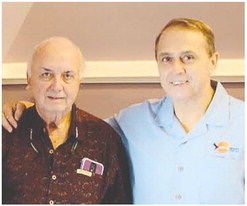
“It’s under contract. We’re going to close in January,” says Minchey, 79, who had the pyramid built in 1994 to house his real estate brokerage firm. Also sold to the same buyer is the used car dealership next door and a tract of vacant land between them and a nearby church.
“They’re going to build a car wash, I understand. A big, probably automated car wash,” Minchey says. “It’s the same folks that put the drive-through car wash up there in Greene County, next to the Shell station across from Reynolds Plantation.”
Minchey admits he’d like to see the pyramid remain. He knows it’s popular among locals, but it’s no longer his decision.
“I would like to think that they would keep the pyramid, they have plenty enough room to put in a car wash,” he reasons. “Maybe this could be a convenience store or just keep it as offices, but that’ll be for them to decide.
“They’re doing all the preliminary stuff now. They already met with Piedmont Water and got that out of the way to make sure everything was going to work for them. And I know they already met with Putnam County, but I don’t know how far they got with their engineers working on how they’re going to put the structure here. So that’s where they’re at now, I think.”
This actually marks the second time Minchey has sold the iconic structure.
Once housing Minchey, his son, Jason, who continues to sell real estate out of a second-floor office, and more than a dozen agents working out of the pyramid from the mid-‘90s to mid-2000s, the building provided office space to 25 workers for various tenants at its peak.
In 2006, Minchey sold his pyramid for $932,000 to a married couple previously working as agents for him.
“The economy tanked, they went under, and the bank took it back. We actually had it listed for sale,” Jason Minchey recalls. “Then Dad decided, ‘Well, let’s just go ahead and buy it back.’” “We bought it back in January of 2018 for $410,000,” the elder Minchey interjects. “Pretty good deal.”
Construction began on the pyramid on Memorial Day 1994, and it was finished and open for business on Labor Day that year, just 101 days later, Jack Minchey says. “It cost us $140,000 to build back then, $35 a square foot. We had it paid off within nine months.”
Structurally, Jack describes it as “one giant roof,” now sporting its third complete set of shingles over its life so far. The pyramid is built of 2X6 and 2X4 lumber, covered by plywood, and bolted to a large concrete pad, which supports the occupied footprint of the structure. With a 10-foot overhang all around its perimeter, “no part of it touches the ground,” Minchey points out.
All of the pyramid’s HVAC and utility systems are housed either outside or between the vertical interior walls and the slanted roof exterior.
“We learned that from going back to the Sylvania pyramid,” Jack says. “We wanted to know what we could do better with this one, and getting easier access to the utilities was the one thing that really stood out.”
At 40 feet tall, Jack admits he would have preferred building the pyramid higher but couldn’t because Putnam County had a 40-foot height limit at the time, primarily for firefighting reasons.
Like the famous Pyramids of Giza, Minchey’s Putnam pyramid is accurately oriented to the four points of the compass, with its front-right point at true north. Its inspiration, however, is not so far-flung.
“I actually built my first pyramid after seeing the Luxor Hotel in Las Vegas,” Jack says. “It had elevators that ran on a slant up the walls. I just thought it was so cool back then.” He says he briefly considered installing an elevator at the Putnam location, but the cost was prohibitive.
However, Minchey did install showers and a complete kitchen.
“We had two companies here,” he explains. “The first floor was the agents who sold the residential and lakefront property. The second floor was called Georgia Wildlife Unlimited, and they hunted land and timber tracts. These guys were always out in the field showing properties. A hundred acres, 200 acres, that kind of thing. So, my thinking was, well, if they come back all hot and sweaty and they still have something else to do, they can jump in the shower here real quick instead of having to go all the way back home.”
At this, Jason is reminded of another unique feature his father installed in the building.
“It’s actually kind of funny, but when Dad was building this, he was watching a TV show about a bunch of lawyers, Ally McBeal, that featured a unisex bathroom, so that’s what he decided to do here,” Jason says. When asked if he regretted that decision now, Jack insists no, and points out he also made the single restroom large enough to be handicap-equipped.
“Most buildings weren’t putting in handicapped bathrooms in the early ‘90s,” Jack points out. “I was very forward-thinking at the time.”
Entering the structure today, a seamstress has space on the ground floor, as does a floral designer and longtime tenant Suzanne Arneu, a certified public accountant who’s been a tenant with the Mincheys almost since the pyramid’s opening.
The second floor features a central octagonal reception area surrounded by a couple of offices, including Jason’s, plus storage rooms and utility closets, with stairs leading to Jack’s office above.
“That’s the one thing everyone says after they’ve been here, that it’s much bigger inside than what it looks outside,” Jason says about the approximately 4,000-square-foot interior. Though his father has slowed down a little, Jack’s office remains essentially untouched and ready for business, encompassing the entire third floor of the structure, from slantedwall- wall, with its peak soaring 20 feet above.
“It used to have a four-foot, clear glass peak at the top. It cost $5,000 just for that but I really wanted it,” Jack says. “I loved looking up and seeing the sky and the clouds and birds going by. And at night, you could see the moon and especially if it was a little foggy, the light inside here would shoot up like a beam in the sky, just like at the Luxor, only we didn’t have any lights actually aimed at the sky.”
Minchey said members of Dwight York’s Nuwaubian Nation visited him in the late 1990s, asking to purchase the architectural plans for his pyramid, designed by Atlanta architect Henry Norris.
“They said that Dr. Malachi had a vision and that he saw angels dancing around a pyramid with a glass top, so they wanted to build one just like it,” Jack recalls. “So I said, well, okay, go back and talk to Dr. York and tell him I’ll give him the plans if he sends me all the people coming in there to buy real estate exclusively from me.
“So, I gave them the plans and I sent my builder out there to help them build the first one. But they built it all really cheap, they watched him, and then they built the rest,” he says.
“But the sad end of the story, once they left here, the glass started leaking and we sent the best commercial roofers up there. They could not find the leak and it was coming down the stringers, so they recommended to just take the glass off and finish it out like a regular pyramid. So that’s what we did. And the story was those angels were dark angels that were flying around the top, and that’s why it started leaking.
“It fixed the leak,” he concedes. “But it never was as much fun.”