
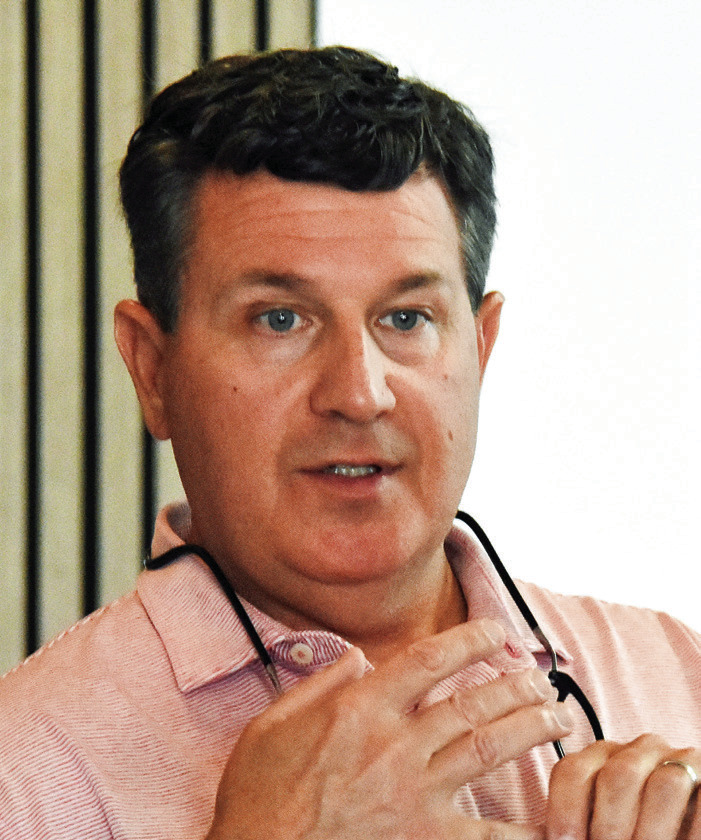
Georgia House of Representatives member Trey Rhodes (R, District 124) recently addressed the Eatonton-Putnam Tourism, Arts, and Heritage (EPTAH) group during its regularly scheduled monthly meeting.
Rhodes provided updates on several topics and took questions from local government, service organizations, and community leaders during the May 18 gathering at the Eatonton-Putnam Chamber of Commerce in downtown Eatonton.
Rhodes opened by discussing the recently passed state budget of approximately $37.8 billion, compared to the $16.7 billion budget he initially proposed after taking office 11 years ago.
“The state of Georgia is kind of a product of its success,” Rhodes said. “I mean, I know how well we do things, and everybody wants to come, and that’s what we’re seeing here locally. So, it is tough to handle, but we’ve just got to try to handle it the best we can as far as the budget goes.”
Specifically, Rhodes referred to the Georgia House cutting the state income tax rate from 5.39% to 5.19%, representing “about $400 million in our budget for every tenth cut, so we cut income taxes by $800 million.”
He also mentioned a billion-dollar [statewide] rebate when you file your taxes,” represented by a $250 rebate for single taxpayers and $500 rebates for joint filers.
“We also created a new $250 income child tax credit for children under the age of six, expanding what we had done the previous year, bringing it to help our younger families that have younger kids,” he added.
Rhodes also praised county voters for approving House Bill 92 last year, which he said provides property tax relief, and emphasized the legislative measures taken to set insurance rate caps, implement income tax cuts, establish child tax credits, and other consumer cost-saving measures. He also complimented the county on having what he said is, “the 11th lowest millage rate in the state.”
Rhodes later addressed a question about why the state taxes necessities like most groceries, when nearby states, specifically Florida, do not.
He answered by stating that any time a budget is set, some sort of baseline and predictability must first be established. Eliminating income tax can be a double-edged sword, he suggested.
“If we ever get to that and we start cutting our state income a lot more, all the goods and services – drugs, haircuts, legal services – all those things that we don’t pay taxes on or sales tax, we would then be forced to start paying sales tax on,” Rhodes said.
Moving on to healthcare access and affordability, Rhodes stated that the state’s Republican government allocated $8.8 million in new funding for maternal health and increased Medicaid reimbursements. He also mentioned $7.4 million in new funding going to graduate medical education.
“As you all know, in rural Georgia we’re dying for doctors, so basically we’re gone into Morehouse, Mercer, University of Georgia, we had a new dental school down in Statesboro; so we’re going in and basically giving a lot of, you may want to call it loan forgiveness or grants or whatever, but if these kids and these individuals commit to rural Georgia and agree to stay for a certain extended time, we’re helping them with their expenses through med school and dental school.”
Rhodes said he and his fellow House members are also trying to address potential school violence by insisting on legislation to create a database of disciplinary issues that would follow any student throughout their school career. He suggested this kind of database might have helped prevent a school shooting that killed four students last September at Apalachee High School in Winder.
He added that $162 million is earmarked by the state for school security, with individual school boards able to determine on their own how best to spend their allotments.
Not surprisingly, road construction, specifically on Hwy.44 between Eatonton and Greensboro, also came up as a topic.
Rhodes acknowledged that things are likely to get worse before they get better, especially at a critical point like the bridge across Lake Oconee.
“The latest is they (DOT) are going to build a new bridge because they didn’t realize the other one was in such bad shape,” Rhodes said. “So, they’re going to be side-by-side, but we’ll use what we’ve got while they build the new one, and then they’ll open that one up and repair the other one.”
Rhodes acknowledged that it will probably involve “at least” a six or seven-year plan.
“I was told it was going to be 18 months of just barging in boulders and rock just to build a bridge,” he admitted.
Not surprisingly, housing needs were also discussed, as Rhodes recognized that Putnam County is facing a shortage of affordable, some prefer the word “attainable” – options for its workforce.
He admitted to being unsure of the state’s financial commitment to the issue but said he recalled approximately $150 million was earmarked for the cause in last year’s budget.
Rhodes closed his comments by thanking EPTAH for the opportunity to address the meeting and encouraged its members and all Putnam County citizens to contact his office with questions at 404-656-5099 or trey.rhodes@house.ga.gov.