
After the arrest of six local men last week on drug-selling-related charges, local authorities expressed fervent frustration at the number of previous times the suspects had been convicted of similar charges.
Those arrested were Christopher Alexis Hill, 35; Oscar Dunn, 63; Stanley Lashun Ingram, 51; Edgar Alexis Amaya, 29, all of Eatonton; and Jim Henry Aikens, 49, of Madison. Arrested separately on similar charges was Eddie Frank Jones, 74, also of Eatonton.
The months-long investigation that led up to the arrests involved a combined effort between Eatonton Police Chief Howell Cardwell and Putnam County Sheriff’s Lt. Harry Luke.
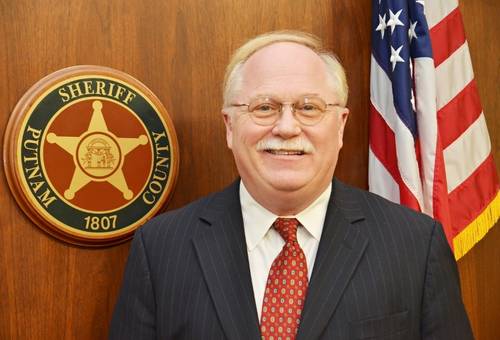
As he went over the suspects’ booking information, Putnam County Sheriff Howard R. Sills had his red “recidivist” stamp ready to mark the reports.
Hill had a criminal record going back to 2007, receiving probation each time. Hill’s most recent conviction for sale of methamphetamine and cocaine was in August 2022, according to the sheriff.
“He got 30 more years of probation for those charges,” Sills added. “So how much of those many years of probation taught him not to do this anymore?”
For Hill’s most recent arrest on March 30, he led authorities on a high-speed car chase for 14 miles, putting other drivers and the pursuing law enforcement officers in danger. Two handguns confiscated from his home were significant because several of his previous arrests and convictions included possession of firearm charges as well as aggravated assault.
“The guns didn’t commit the crimes, he did,” the veteran sheriff emphasized. “Over 14 miles we chased him… People want to know about crime, that’s the reality. It’s not the exception, it’s the reality.”
Regarding Amaya, Sills noted he was placed on First-Offender Probation in Hancock County for burglary, but subsequently was arrested in Baldwin and Jones counties on other charges before the most recent arrest in Putnam.
“For First Offender Probation, if you violate it, you get the maximum penalty," Sills said. "Have I ever seen that happen? No, but that’s what they (judges) tell them.
Sheriff Sills also said Aiken’s criminal history goes back to 1991, and in August 2006, he received his sixth felony conviction, for which he only was sentenced to seven years of probation. But then federal authorities convicted him of selling cocaine in 2010, and he was sentenced in federal court to serve 151 months in confinement plus three years of probation.
“That expired March 5, but these drug sale charges we arrested him on, the sales were made while he was on probation, so we see how well that works,” the sheriff opined. “If all they have to do is call into probation, then how’s it doing anything? And when we go to their house, guess what? They’ve got all kinds of drugs in their house.”
Dunn’s convictions began in 1989, Sills said, and the first two resulted in several years of probation. In June 1997, he was sentenced to 30 years, with 15 to be served in confinement and 15 on probation, which would end in 2027.
But he was arrested again in July 2010 and given an additional 12 months of probation; and again in 2014 for the sale of cocaine, he received another five years probation, which obviously means he violated his probation but was still on the streets committing crimes.
A 1972 conviction for “prison escape” is the earliest item Sills could find on Jones’ criminal history report. The convictions and probation sentences every few years are too numerous to list, but those that stood out to The Eatonton Messenger reporter include an October 1992 felony conviction for cocaine sales, with a sentence of 15 years, eight of those in confinement. But less than four years later, he was convicted again, and sentenced to 20 years, which would’ve ended in 2016. But he was arrested in 2003 for probation violation, and the numerous drug sales convictions and sentences continued until his 10th felony in 2017.
There, the sheriff paused.
“This is just so people can get a perspective of what really goes on,” he said. “I don’t understand why the public cannot grasp that unless we have massive incarcerations, we will have massive crime. I don’t mean lock up everybody, I mean we should target people who the law says we’re supposed to, and give them what the law says they’re supposed to get.”
Although he noted that judges should penalize those who violate their probation requirements, Sills said the state bears most of the blame.
“They are sent to state prison and then before their time is up, they’re released and end up back at the county jail, where the county landowner foots the bill,” he said. “It’s designed that way, so the state makes itself look good.”