
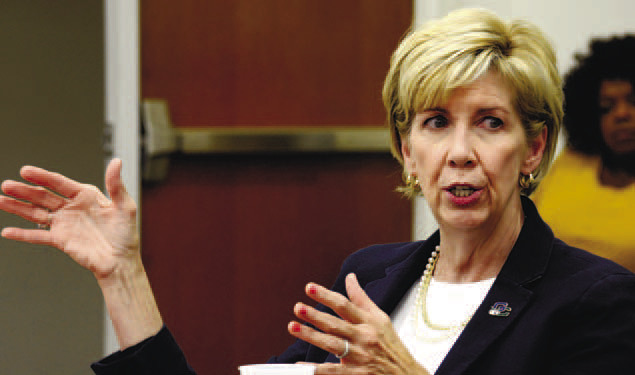
Barely a month in office as president of Georgia College, Cathy Cox is often out of the office and on the road touting “GC,” as it’s commonly known, on its purpose, its economic impact, its potential for partnerships.
Cox spoke to the Eatonton-Putnam Tourism, Arts, and History Partnership (EPTAHP) Sept. 21, ending her talk with a pledge to the region’s communities, “The door is wide open to support.”
But she started with the basics, even some comments about the name of the institution and a strong defense of its motto as a “liberal arts college.”
While the official name remains Georgia College and State University (GCSU)—a nod to a time not too long ago when four-year schools around the country wanted emphasis on graduate programs they began offering—Cox leans more toward the simpler “Georgia College” in casual references.
“It is such a mouthful,” she said, adding that the formal title often gets confused with Georgia State University in Atlanta.
On other topics, Cox said:
• This fall’s GCSU enrolment reached a little over 5,300, which is down some from its peak a few years ago;
• U.S. News and World Report ranked Georgia College No. 1 for nursing schools in Georgia;
• The college was moving to an “open standard” of admissions that makes optional taking the SAT or ACT test, leaving the University of Georgia and Georgia Tech as the only state schools still requiring one of them. Instead, GC will move toward a more “holistic” approach that considers not only high school grade point averages, but the average of core courses, elective courses taken (and those avoided), indications of leadership skills, and recommendations. “This will help with our local students;”
• TheGCworkforceof 900 full-time and 250 part-time employees, plus 1,000 work-study students, not only maintain homes in Baldwin County, but in surrounding counties like Putnam and Greene, too. Their total annual payroll of $65 million, plus student spending estimated at $68 million, makes for a “huge economic impact;”
• Anylargeincreases in GC student population are “not likely. We do not operate on a growth model. It has to do with how we teach. We have small classes; 40 to 50 percent of our classes have 20 or fewer students; only 2 percent have 50 or more. We do not even have a big lecture hall.
It (large growth) would just change what we are. It would change the structure of what we offer. We would have to build more housing, and the Regents do not want more housing. The merchants may want more, but many residents do not.” As for the “liberal arts,” the former secretary of state and 2006 candidate for governor emphasized “it has nothing to do” with the liberal/conservative split in politics. Rather, it comes from an older use of the word, which points to a broad, diversified education with interconnections among disciplines.
“It is the foundation of everything we do at Georgia College,” Cox said. “Nursing, education, business and economics, the sciences; they all have a liberal arts foundation.”
While business interests (and some parents) may push for more job-training skills, Cox argued that “critical thinking, problem- solving, communication skills, teamwork; these are work-force skills … we embed them in all majors, from undergraduate research to studyabroad … every senior has a capstone project in which they have to show they can write and speak well.”