
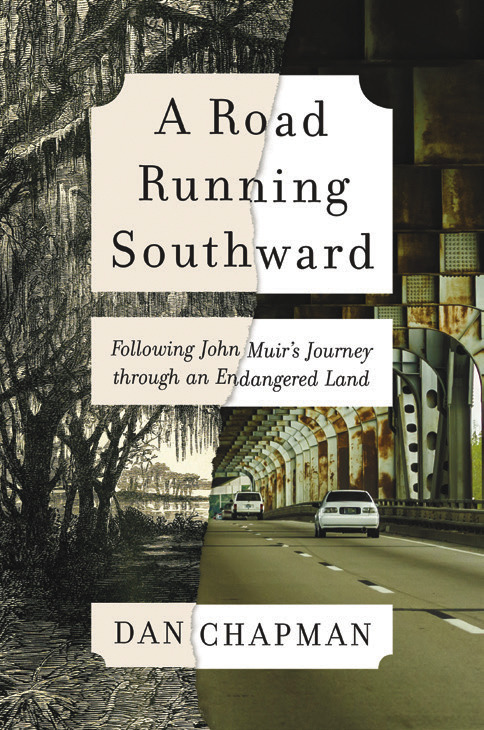
We associate John Muir, one of the patron saints of the environmental movement, with majestic mountains out west – with Yosemite and the Sierra Nevada and Muir Woods, the redwood forest that bears his name near San Francisco – his legacy does not usually summon thoughts of the Southeast. But that’s where his devotion to the natural world first took wing.
In 1867, Muir, a 29-year-old Scottish immigrant living in Indiana, hiked from Kentucky to Florida, scribbling notes for a travelog he published under the title A Thousand-Mile Walk to the Gulf. A century and a half later, Dan Chapman, a veteran environmental journalist (and former colleague of mine at The Atlanta Journal-Constitution), retraced Muir’s steps for an updated travelogue that illuminates, entertains, and raises sobering questions.
A Road Running Southward begins with an act of trespassing, as Chapman hops the fence at Savannah’s Bonaventure Cemetery to spend the night.
Muir camped at Bonaventure for almost a week while he waited for his brother to send him funds to continue his travels. He grew weak from hunger and started thinking deeply about the natural order of things and why human beings were assumed to be lord and master over other living forms. It was something like a religious epiphany, writes Chapman, whose own tribulations at Bonaventure were due to another living form: mosquitoes.
Muir went on to cofound the Sierra Club and lay the groundwork for the national parks system.
He was something of a 19th-century hippie, in Chapman’s estimation, a “shaggy, poetry-spouting, draft-dodging Bohemian [who] thumbed his nose at conventional wisdom, religious orthodoxy, and societal mores.”
In walking through Kentucky, Tennessee, Georgia, and Florida, Muir was communing with a part of the country whose natural bounty is perpetually under-appreciated.
As Chapman points out, nearly two-thirds of all American fish species live in Southeastern streams, and more than 90 percent of our bird species live here or pass through.
All that was easier to see in Muir’s day. A century and a half later, highways have dissected the land, industries have troubled the waters, and cities have fouled the very air we breathe. Would Muir be pleased by what’s become of the land he traversed shortly after the end of the Civil War?
“He would cry in his beer today,” Chapman writes.
Chapman will be Georgia Writers Museum’s “Meet the Author” presenter Tuesday, June 6, at the museum in downtown Eatonton (109 S. Jefferson Ave.) with doors open at 6:30 p.m. for a 7 p.m. program start. Tickets are $20 each ($15 each for two or more), or $100 for a table of six.
Chapman also will be signing copies of his book, which can be pre-ordered from the museum now.
To register, call GWM at 706-991-5119 or visit online at georgiawritersmuseum.org.
Jim Auchmutey is a former reporter and award-winning editor of The Atlanta Journal-Constitution and a best-selling author of several books, including Smokelore: A Short History of Barbecue in America, also available through the GWM bookstore.