
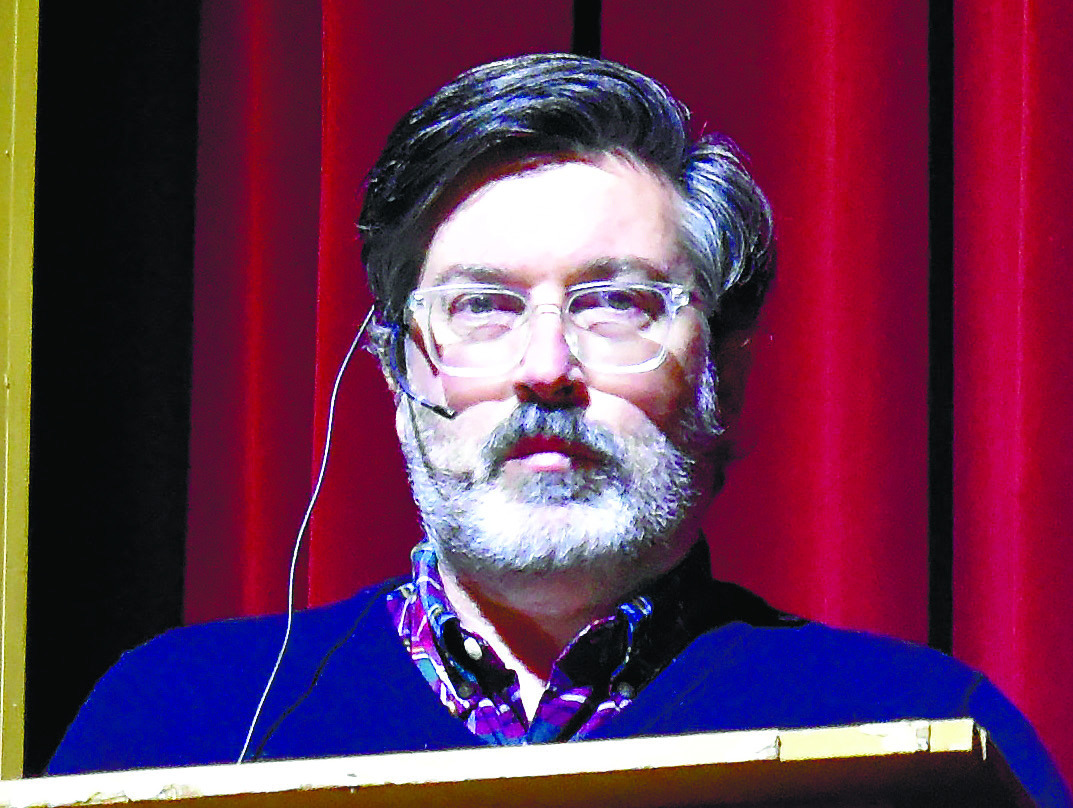
As part of Historic Preservation Month, Eatonton’s Old School History Museum (OSHM) hosted a lecture on May 7, “Architecture in Georgia: A Diagnostic Sampler of Type and Style, 1800-1940.”
The Eatonton-Putnam Historical Society and the Eatonton Historic Preservation Commission participated in and supported the program presented by Joe Smith, an Athens-based preservation architect, and educator.
Smith earned a bachelor's degree in design from Duke University and a master’s in architecture from the Yale School of Architecture. Since 2005, he has participated in the rehabilitation of more than 100 historic structures in Georgia, his most recent project being the restoration of Savannah City Hall.
In 2017, Smith co-founded The Architectural Collaborative, in Athens with partners Lori Bork Newcomer and Gabriel Comstock. Their rehabilitation and restoration work has won several Georgia Trust preservation awards, as well as recognition by AIA Atlanta and AIA Georgia. Since 2011, Smith has taught courses to preservation graduate students at Georgia State and later at the University of Georgia.
Smith has lived in Madison since 2005, where he served on the Madison Historic Preservation Commission. He also served on the Georgia National Register Review Board, which he chaired in 2019-20. Recently, Smith wrote a chapter on the antebellum period for the Georgia Trusts’ upcoming book on the architecture of our state.
'I've been his fan for years,' OSHM board member Lyn Romine said while introducing Smith. 'I've been to his workshops and state-level conferences, and he is always so knowledgeable.'
Smith began by explaining the difference between styles and types in architecture. If the style is a combination of details, architectural elements, window patterns, finishes, and materials, then type refers to the room layout, form, and scale. Not every building has a style, he said, but some involve a combination of styles. Folk buildings following local traditions are called 'vernacular.'
According to Smith, Georgia in the 1700s had five primary styles of buildings, the number of which grew to 15 in the 1800s and to 18 in the 1900s.
When it goes to the types, he said buildings are divided into two main categories – residential and commercial – which, in turn, are divided into subcategories. Smith explained each style and type as well as their combinations by using numerous slides with photos of buildings all over Georgia.
“A lot of people just don't realize what they are,” he said. “Once you know what to look for, you start to see them.”
For instance, Smith suggested audience members may have heard of the term “Milledgeville Federal” as a style and explained it “was called this way because in the 1820s Milledgeville was a state capital. Its portico--front-of-portico being the kind of two-story porch element.
“The craftsmanship of everything inside that porch is splendid, of the highest order,” Smith said. “Often the craftsmanship of Milledgeville Federal houses meets or exceeds that of places like Salem, Massachusetts, where a carpenter architect Samuel McIntire worked, and the whole historic district is named after him.'
Smith mentioned that the Episcopal Church of the Advent in Madison, dating back to 1844, is the earliest gothic revival church in Georgia, whereas the Church of the Redeemer in Greensboro, built in the late 1860s, is a carpenter gothic example.
“It was very insightful,” said Jim Stone, who attended the lecture with his wife Roxanne to get guidance on the restoration of their house on Church Street in Eatonton.
For more information about OSHM, and its upcoming events or to sign up for its monthly e-newsletter, visit online at oldschoolhistorymuseum.org.