
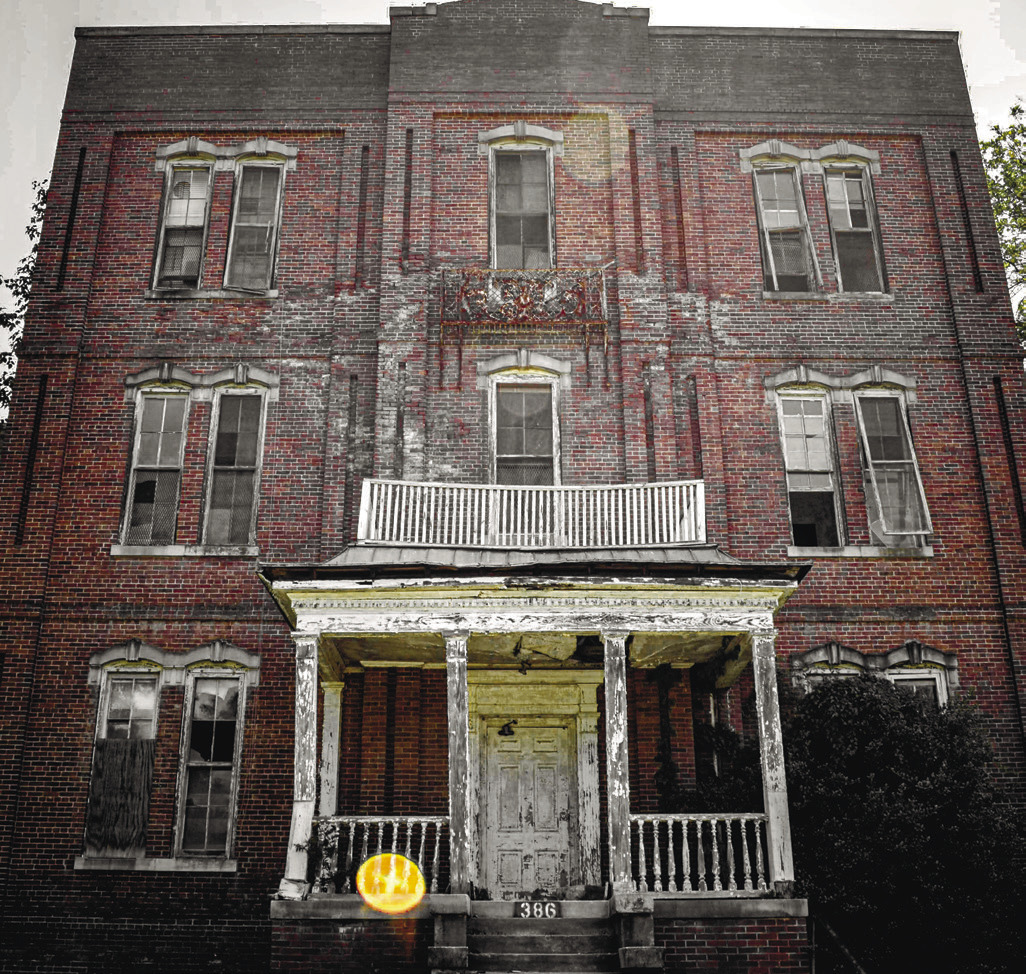
Gov. Brian Kemp signed an executive order last Tuesday authorizing the Department of Behavioral Health and Developmental Disabilities (DBHDD) to “dispose” of the Jones, Green, Walker, and Wash buildings on the Central State Hospital (CSH) campus.
The Jones Building is approximately 142,140 square feet and was originally built in the 1920s.
It served as a hospital treating Central State patients, employees, and local residents. It was in use for about 50 years before its closure.
The Green Building resides next to the Chapel of All Faiths on Swint Avenue and was opened in 1947. The 62,284-square-foot building was named after former CSH superintendent Dr. Thomas F. Greene, who served until 1874 and instituted a number of changes at the hospital including abolishing forms of restraints and instituting a system of classification among patients.
According to The Historical Marker Database, the Green Building was used to house white convalescent patients who suffered from conditions such as schizophrenia and was repurposed in the 1970s to be used by Baldwin County as the Department of Children and Family Services and Head Start.
The Walker Building is also on Swint Avenue and was built in 1884. The 88,492-square-foot building was opened in 1886 and was originally used as a male convalescent building. The building was used to treat patients until its closing in 1974.
Concluding the buildings being demolished is the “Wash House Building.” The building was formerly used by the Georgia Department of Administrative Services.
On the map attached to the executive order, the building appears to be in between the Powell and Brantley buildings on Peacock Street.
As of last October, the buildings underwent asbestos removal and had chainlink fencing placed around each of them. Since October, the buildings had not been touched and no one had mentioned the demolition or restoration of the buildings until Tuesday.
However, the community has been emotionally invested in the campus for many years and many seek to see the restoration of it.
“I find that here in Milledgeville people talk about the hospital and its decay. People are very emotionally upset about the decay and what we can do, how we can save these buildings,” said Wanda Millan, a Milledgeville local, at the CSH documentary screening on July 22. “They want to know who to blame for the decay and where the decline began.”
Similar to locals, organizations such as the Central State Hospital Redevelopment Authority, Georgia’s Old Capital Heritage Center at the Depot, and Seeking Asylum LLC. wish to see the campus preserved and used.
“It’s very sad to see the removal of these buildings,” said Jessica Whitehead, founder of Seeking Asylum and CSH photographer. “Something that I’ve tried to show through my photography is the beauty of the decay and it’s sad to know that people will no longer be able to see the buildings through that lens in person or see them be restored.”
During the screening of “Central State Hospital: An Oral History,” Central State Hospital Redevelopment Authority Chair Johnny Grant stated that the board is saddened by the decay of the campus and is strongly working to repurpose the buildings.
According to Grant, about 45 of the smaller buildings on campus are in use. However, he clarified that the Redevelopment Authority does not have an interest in the larger buildings at this time due to monetary concerns and the amount of restoration that would be needed for the buildings to be used.
He further stated that for anyone to be able to use the buildings, they must present an economic plan and not just an idea.
“We do not receive any funding and are a self-sufficient subdivision,” said Grant at the documentary screening. “We have very little interest in the larger buildings. It is very expensive to try and renovate one of these larger buildings. The state has declared most of these properties as surplus and the state has a lot of different priorities."
The Department of Behavioral Health, which owns the majority of these properties, basically says “We are not in the business of keeping buildings up. We are in the business of mental health services. So, these buildings don’t have a current use.”
According to DBHDD Communications Director Ryan King, DBHDD explored in-depth the alternative options for these properties but determined that demolition was the only “viable option to mitigate the significant and potentially deadly risk” the buildings pose to the public.
An exact timeline is yet to be determined but the goal is to complete demolition by this fall.
“We’ve performed evaluations and the abatement of harmful materials on the properties with the aim of making salvage and repair possible. Ultimately, it was determined that demolition was the only viable option to mitigate the significant and potentially deadly risk these buildings pose to the public and to create a path for the property to be revitalized,” said King. “In an abundance of caution, we will work with the Historic Preservation Division of the Department of Community Affairs to mitigate the historic impact of the demolition of the buildings.”
According to King, the Powell Building will become a centerpiece that will “spur and support workforce development.”
“It’s important to understand the Powell Building will remain intact and serve as a centerpiece in potential reinvestment and redevelopment plans,” said King. “Reinvestment with the Powell Building as a centerpiece will spur and support workforce development, a key to breathing life back into the campus. Central State can ultimately be the site that delivers the training and experience necessary to positively impact the workforce shortage we’re experiencing.”