
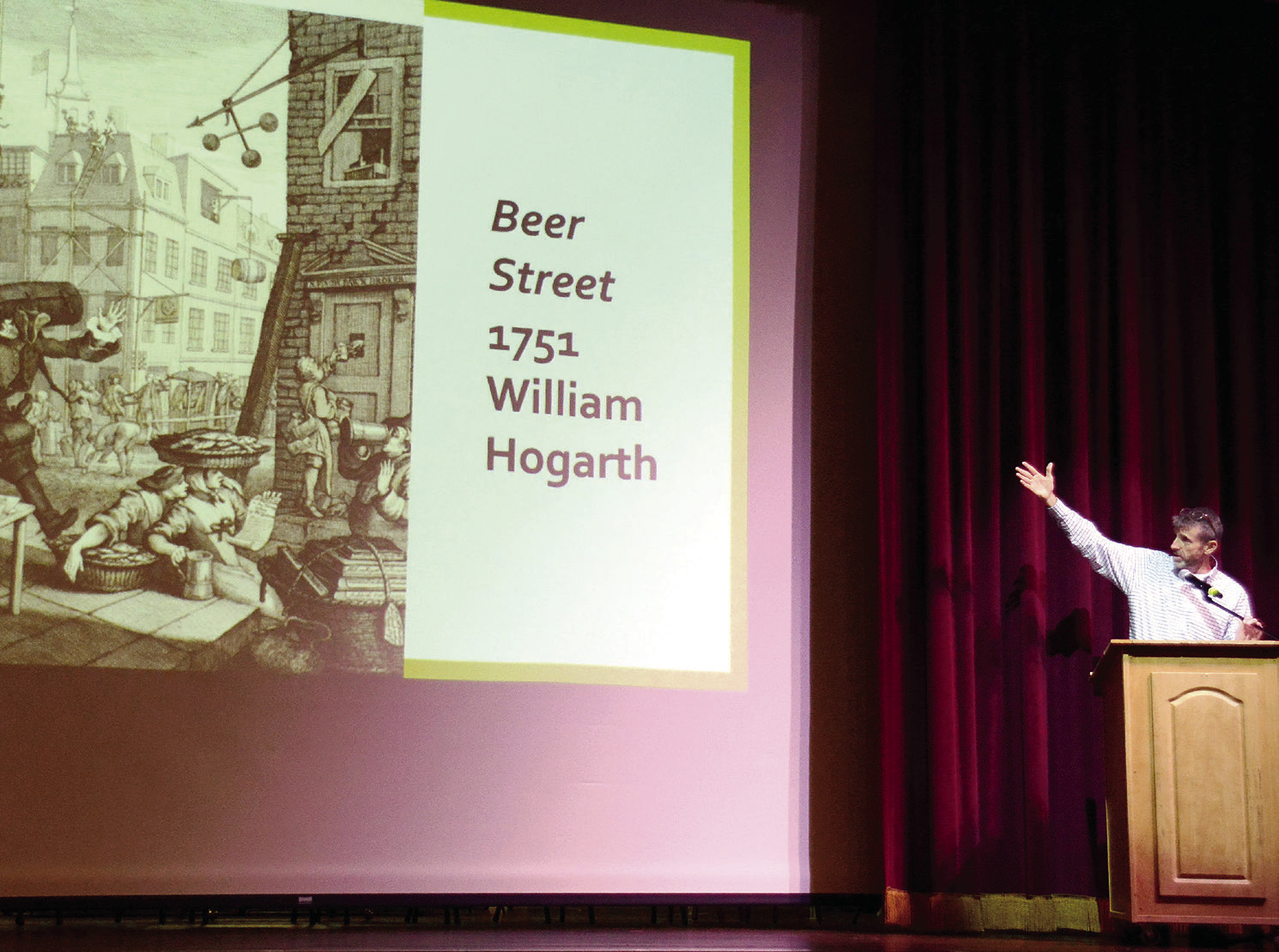

On Sunday, people gathered in The Plaza Arts Center theater to hear Dr. Eric Tenbus, dean of the College of Arts & Sciences at Georgia College & State University, discuss “The History of Beer.”
Tenbus’ presentation was part of the Old School History Museum’s Sunday at the Museum lecture series.
“And today marks another special day. This lecture is the 50th lecture since we started the series in 2014,” OSHM Director Sandra Rosseter said while introducing Tenbus. “We are so excited!”
Tenbus opened his talk by showing a movie clip from “National Lampoon’s Vacation” – an iconic scene in which Rusty shares his first beer with his dad – although Rusty does most of the drinking and triumphantly crushes the can upon completion.
He then opened the floor to audience members to test their general beer knowledge in a Kahoot quiz on worldwide beer production and sales. This got everyone talking and laughing before the main presentation started.
“More than 192 billion liters of beer were produced last year,” Tenbus said during one quiz answer. “That’s more than 50.7 billion gallons of beer and more than 541 billion 12-ounce bottles. That’s a lot of bottles of beer on the wall!”
His talk, “National Identity, Nostalgia, and Beer Politics,” focused on the British Beerhouse Act of 1830.
Since beer’s history is so long and extensive, going back to ancient times, Tenbus had to narrow his focus. He took the audience back to 18th- and 19th-century England, when alcohol consumption significantly influenced the nation’s politics.
Tenbus spoke of the rise of a new Gin Age in the early half of the 19th century, approximately 70 years after London and the rest of the country experienced its first Gin Age.
“That was when famous printmaker and artist William Hogarth created his famous print, 'Gin Lane,' in 1751,” Tenbus explained as he displayed a Hogarth editorial cartoon work depicting a disturbing scene aimed to persuade and influence behaviors surrounding drinking gin by describing its negative, sometimes deadly, effect on people’s behavior.
Tenbus said similar social commentary followed in the 19th century, as Charles Dickens wrote “Sketches by Boz,” which remarked on everyday life of the time.
Tenbus explained that politics got involved because these problems were reflected in art and writing.
“So, to remediate this earlier gin age in the 1700s, parliament passed high taxes and raised the price of gin. However, the high taxes on gin led to smuggling. In 1825, parliament reduced the duty on gin by 40% to cut down on the massive smuggling that was happening in Great Britain,” he added.
This period was also tumultuous for other reasons, including the death of King George IV and the fear of revolution similar to that striking France about the same time. So, with problems of drunken disorder and health concerns spilling from the gin shops, lawmakers of the day and their constituents wanted something done.
“And what was to be done? How do you fix these problems?” Tenbus asked. “Well, of course, the answer was to bring back beer.”
That led to the Beerhouse Act in 1830, essentially creating the beerhouse as a new type of beer retail outlet. Tenbus said the intention was to lower the price of beer by increasing its availability, decreasing the amount of gin drinking, improving the quality of the beer being produced, and helping the agricultural districts by increasing demand for barley, malt, and hops.
It even led to Hogarth penning a companion piece to “Gin Lane,” Tenbus said, explaining the more serene and optimistic “Beer Street” offered “compelling visual rhetoric, supporting the positive attributes of beer as opposed to spirits, to gin, and such.”
He also suggested “Beer Street” and argued for beer as Great Britain's natural and socially improving beverage.
At the same time, gin and the other hard spirits were portrayed as “destructive, unnatural, and immoral, generally un-British,” Tenbus said.
He quickly reminded The Plaza audience that “nostalgic patriotism is not unique to Great Britain or to the 19th century for that matter. A quick Google search reveals plenty of good old American nostalgia wrapped up in beer,” Tenbus said, providing examples of American beer advertising through the ages.
Tenbus concluded his lecture by discussing differences between ales and lagers, such as what glasses they are served in, alcohol percentages, temperatures, and tastes.
Following a round of insightful questions from the audience following his lecture, Tenbus invited everyone to a reception in the attached Old School History Museum, where snacks and several beers for sampling were available so guests could taste the differences for themselves.
Rosseter also encouraged guests to support the OSHM by signing up for its accessible monthly e-newsletter at oldschoolhistorymuseum.org. The newsletter contains information about upcoming events and exciting stories about Eatonton's history.