
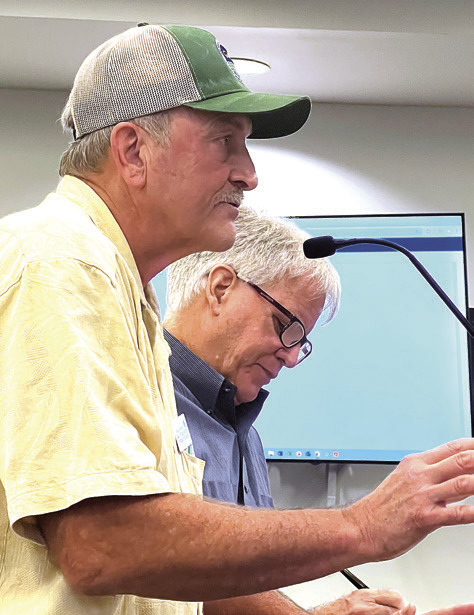
The regularly scheduled Oct. 15 Putnam County Board of Commissioners meeting opened with more than 45 minutes of often spirited debate over redefining 5.44 acres at 133 Whitney Dr. in District 3 from R1R, the most restrictive of all county land designations, to Ag (agricultural), the county’s least restrictive designation.
Several neighbors from the nearby Sebastian Cove subdivision spoke in opposition to the request from landowners Nicholas and Jennifer Marine, who purchased the land in question about three years earlier.
Attorney Jay Dell represented the Marines at the commission meeting.
Among the neighbors’ concerns were the loss of the property as a buffer zone, its potential to combine with adjacent land to create a commercial campground, and its possible use for grazing livestock.
Public presentations and comments lasted about 30 minutes, with the rest of the debate remaining among the council after District 3 Commissioner Stephen Hersey motioned to deny the request.
Eventually, after Hersey made his case in opposition, the motion carried with only Hersey remaining in opposition; however, it carried with four conditions laid out by County Chairman Bill Sharp, including “there shall be no commercial campground, there shall be no commercial uses, there shall be no residential subdivisions, and this parcel shall not be used for short-term rental.”
Regardless, the decision prompted Hersey to tell his commission colleagues, “I do very much appreciate my fellow commissioners honoring a matter that affects my district, and I will certainly remember that in the future.”
Public comments followed, led by Nick Marine, who thanked commissioners for allowing Public Works employees to spread gravel around an exposed culvert pipe.
Next, there was one last complaint about rezoning the Whitney Drive parcel before another citizen again brought up the potential for a campground there. A brief speech opposing the SPLOST 10 initiative followed, followed by questions about what will happen if Putnam General Hospital’s financial needs are not met.
Finally, Hersey stepped down from his seat on the commission dais and took the sixth and final public comment slot.
“It has been brought to my attention that in the Eatonton-Putnam Chamber of Commerce newsletter, they have posted an article concerning SPLOST Number 10 … and at the bottom of this posting, it says what SPLOST 10 is not. “It is not an increase of taxes. True. It is not a new tax. True. It is not a borrowing of funds. That is false,” Hersey declared. “And the Chamber knew that when they posted this. I don’t know who is responsible for it, but I don’t think that we should stand for the Chamber of Commerce publishing a blatant falsehood concerning SPLOST Number 10.
“I don’t care if they sponsor it or whatever they do is their business as a nonprofit. But I think it is wrong for them to be issuing blatantly false statements… Are we giving the Chamber 60% of our hotel-motel tax to print lies? I don’t know.”
And with that, Hersey returned to his seat.
Next, real estate investor and developer George Kelecheck and Greg Ramsey, director of Village Habitat Design, gave a detailed presentation on the importance and necessity of planning commercial and residential development in a county.
Kelecheck pointed out that Putnam County represents approximately 220,500 acres, of which about 91,450 is forested.
“So, you basically have about 58% development,” he said before cautioning the 42% of land remaining must be carefully and strategically stewarded for the future.
Ramsey later advocated for comprehensive urban planning, touting the value of mixed-use developments that blend retail, commercial, residential, and occasionally even industrial structures and activities to create miniature living cities. He described one suburban Atlanta-area county that now has just 2% of undeveloped land left and is trying to regain — literally — lost ground.
He compared a strictly residential development generating approximately $11,000 per acre annually based on municipal property taxes to a big-box retailer on a 34-acre lot paying perhaps $221,000 a year, which equals about $6,500 an acre net to the city. Meanwhile, Ramsey claimed a downtown mixed-use office-residential building could generate as much as $330,000 per acre for city coffers.
“At a minimum, cities add value to their land by providing streets, utility service, police protection, and fire protection. The more spread out a city becomes, the more expensive it is to deliver those services, especially when that acre of land pays less per acre,” he explained. “Unfortunately, when cities consider new developments, too often they focus on taxes that they hope will flow to the city coffers without adequately considering the land base they will use up or the costs they will incur in city after city, big and small.
"When we do the math, it’s clear that dense downtown development is much more productive than anything else in the community. Downtown development is the golden use of urban economics and is the best bet for cities that want to prosper in the long run.”
However, given the overall rural nature of present-day Putnam County, it remained a tough sell, as one commissioner quipped at day’s end, “What was up with the infomercial?”
Still, planning can never begin too soon.