

I’ve been thinking that we probably should discuss a few tackle tips for stripers, hybrids, and whites for our two lakes.
Our tactics and techniques are similar, but a few of us have developed things that help us catch more and better fish on Lakes Sinclair and Oconee in particular. I’m here to shed a little light on those hot tips.
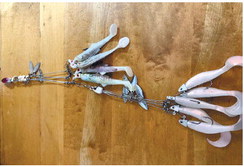
• If you don’t know what a Mini-Mack is, catch up quickly! But there’s a trick to them. One of my buddies and I have started buying the very inexpensive Alabama rigs you can find on eBay and Amazon. What we do is use those in conjunction with Mini-Macks. We create a double rig. This allows you to fish a little deeper and presents a much bigger bait ball to the fish.
The cheaper version of the Alabama rig is tied first in line and all the snaps except one are filled with 1/4-ounce jig heads and shad bodies of some kind. That one snap that’s left empty, we run the real deal Mini-Mack off that one. Ninety percent of our bites come off the back rig and since that is a true Mini-Mack we have a quality piece of gear with the fish on it.
Mack’s rigs don’t twist up and get bent out of shape like the cheaper ones.
• Mini’s run with 1/8-ounce jig heads and 3-inch swim baits.
Keitech’s, Prodigy by Cast Fishing, Suicide Shads, and crappie jig bodies all work well on this technique. It seems that when the bite gets a little tougher getting a closer match to the bait size is working better.
I don’t change my speed or my distance behind the boat from regular minis, but I do change the size of the bait. It works, too! Yes, you will definitely catch more white bass this way, but you will catch stripers and hybrids, too.
• The absolute best terminal tackle box I have found is the Packout (the thin one) by Milwaukee Tools. Yep, a toolbox! It closes tight, it’s waterproof, and unless I really get rough with it, when I end my day all my stuff is in the same place as when I began. It’s kind of expensive in comparison to a regular Plano box but well worth the expense.
Honestly, I have two of them now and they keep my terminal tackle and my jig heads well organized and safe.
• How to troll slower with your main engine. I have a 20-foot Pathfinder and a 150-horse Yamaha.
The absolute slowest I can get my boat with the big motor is around 2.8 mph.
Now a lot of times I want to go at least another mile an hour slower. The way I have solved this problem is to rig a drift sock to tow behind my boat. A drift sock is something we use flats fishing on very windy days. It is meant to slow your drift down or even act like an anchor in some cases. I take a dock line and run it from one cleat to the other off the stern of the boat. Then center the sock off the engine and suddenly I am going around 1.5-1.8 mph, depending on some other variables. Plenty slow enough to troll minis and crankbaits, or even live bait if I need to when it’s too windy to use my trolling motor.
• When trolling minis and big umbrella rigs, the line makes a difference!
Now 90% of the time, if I’m pulling a full-sized umbrella I am using 30 or 30-40-pound monofilament. However, mono has a good bit of drag to it. It keeps those rigs higher in the water column. If you want to gain a little more depth and add a lot of strength switch to braid.
You will add a significant amount of depth to your setup, and you can go with a 120-pound braid that will quite frankly pull up any tree you happen to get hung on in Sinclair or Oconee.
Good luck as we come into the best fishing of the year, folks! Remember, you can now book a trip with me as well!