
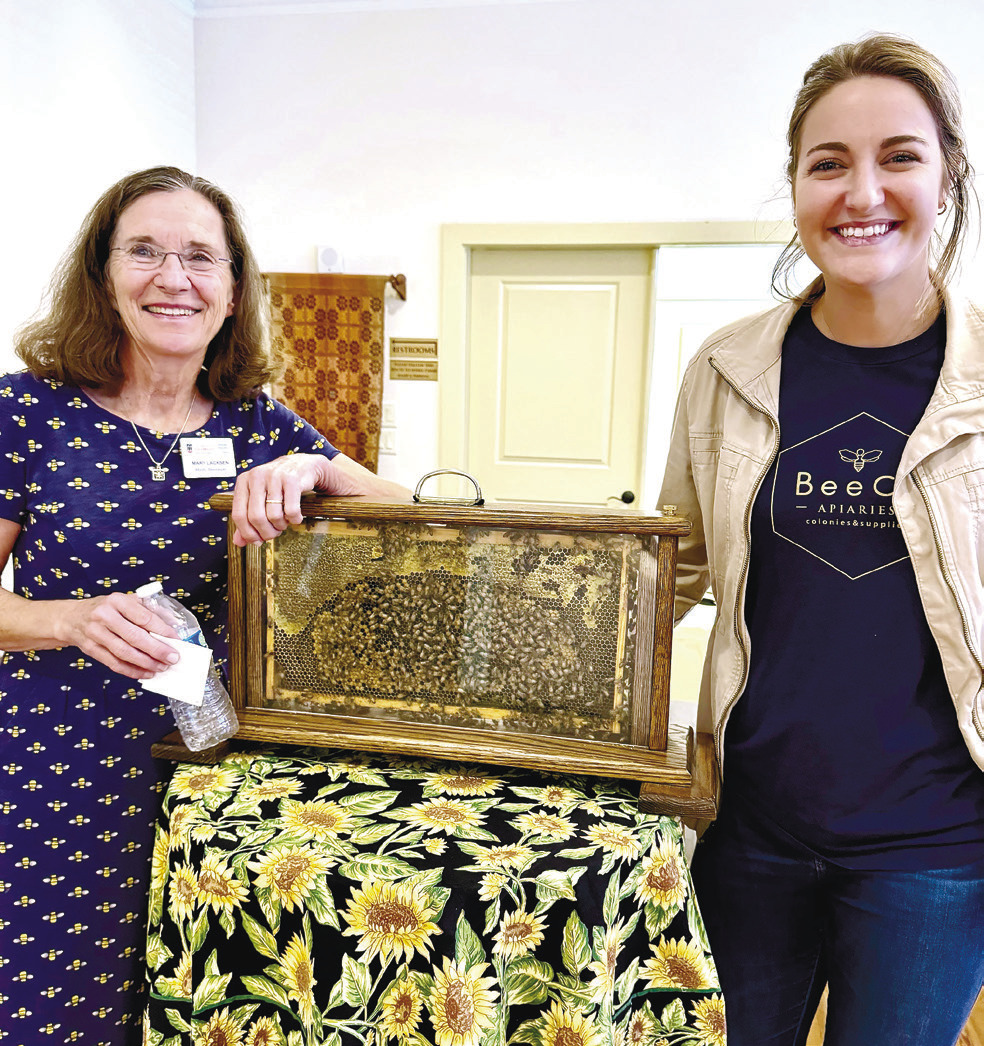
This story features the buzz of the bees. Or at least as much as Georgia master beekeeper Mary Lacksen could pack into an hour’s presentation during the Old School History Museum’s most recent installment of its Sunday-at-the-Museum lecture series.
Lacksen and her daughter Katherine run BeeCo Apiaries (beecoapiaries.com) on the family farm near Sparta. Her journey into beekeeping began about 15 years ago and the “master beekeeper” designation took four years of study to earn during that time.
From the beginning of her talk last Sunday, Lacksen emphasized her point was not to turn people into beekeepers but to introduce them to the wonders – and impact – of the otherwise innocuous little honeybee.
Among the nuggets from her presentation were that bees and their cousins (wasps, hornets, dirt daubers, etc.) account for 20,000 species worldwide.
Some 4,000 are found in the United States, but the dominant bee strain here is the Italian honeybee, which generally are known to be smaller and gentler than some of the other strains.
Also, bees (bumble, carpenter, mason, honey) in general have barbed stingers, which means they can sting only once because that leaves part of their bodies behind and they die soon afterward.
Remarkably, a third of our food supply has been pollinated by bees minding their own business out looking for nectar in blossoming plants. In the process, they collect pollen in their very visible “pollen baskets” for their own use – all the while pollinating nearby blossoms on their rounds.
Somewhat surprisingly, though, the honeybees’ most dominant influence comes with the one million acres of almond trees in California’s Central Valley, which produces 80 percent of the world’s almond supply.
Bees form colonies ranging in size between 6,000 to 100,000 individuals and there are an estimated three million colonies across the U.S.
However, bees do not overwinter on the East and West Coasts, preferring the Southeast.
The nation’s commercial beekeepers, like Lacksen, put their hives on trucks and move them around the country to take advantage of different blossoming seasons. A commercial beekeeper may have 10,000 hives and each hive has one queen, which lays up to 2,000 eggs a day.
Another 30 to 100 bees in a hive are (male) drones, who “eat a lot, breed, and then die,” Lacksen said during her presentation.
“It’s just part of life.”
Meanwhile, tending to all the maintenance duties of the hive are 60 to a hundred (female) worker bees, while scout bees will fly up to five miles from the hive in search of blossoms.
They find their way back to their own hives through a refined sense of smell, picking up distinctive pheromones put out by individual queen bees.
Lacksen explained the workers communicate to other worker bees about where the blossoms are through a vibrating “waggle dance,” (of which the discovery earned its founder a Nobel prize). The length of the “dance” will signal the distance and the angle from the sun.
“The best part of beekeeping is just watching the bees,” Lacksen stated.
She also explained honey has varying flavors and different colors, depending on the blossoms the bees visit. With more than 3,000 varieties of honey, colors vary from white to dark amber, while flavors can range from clover and tupelo to lavender and sourwood.
Lacksen said she prefers privet, but sourwood tends to be the gold standard for honey, if for no other reason than its relative rarity. Sourwood trees grow in a broad band across the Southeast, but best above 3,000 feet in the North Carolina Smokies, where Lacksen said she puts her hives for about six weeks each spring.
One flavor she adamantly avoids, however, is goldenrod and Lacksen said she will quickly move her hives to avoid it. The honey from such fields “smells like rotten socks,” she claimed.
Then added after a short pause, “Tastes like it, too.”