
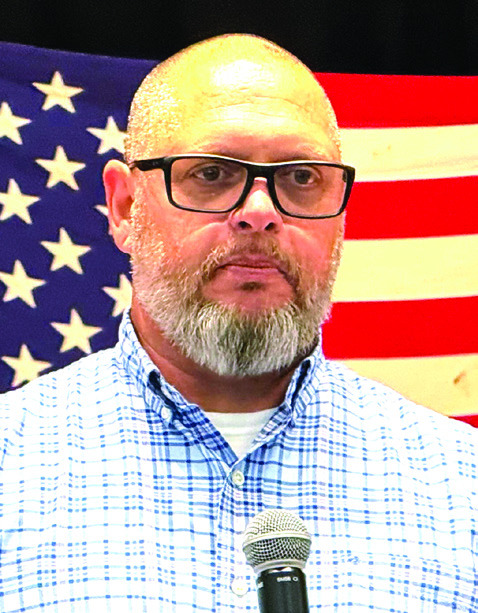
When former Marine and current youth pastor Johnny Griffith took the stage at Gatewood Schools’ Veterans Day program last Thursday, he wasn’t exactly sure how to begin.
“I’ve never actually done one of these things for veterans,” he admitted to a full audience in the school’s new building. “But luckily I love to talk, so we’ll figure it out together.”
What followed wasn’t just a story about military service — it was a story about identity, loss, and redemption.
Griffith said he grew up in Putnam County and graduated from Putnam County High School in 1993. He thought he’d study forestry, but after “flunking out” of Abraham Baldwin Agricultural College due to what he called “a lack of discipline,” Griffith decided to enlist in the United States Marine Corps. That decision, he said, gave him purpose and something he hadn’t previously found — a real sense of who he was as a man and as a person.
“The Marine Corps became my family,” he told a rapt audience. “The camaraderie, the team experience, you really can’t beat that.”
Griffith said he excelled in the Marines, earning promotions quickly and even being selected for the prestigious drill instructor path at Parris Island. Everything was going according to plan — until it wasn’t.
While deployed in Norway for training, Griffith said he began getting sick. His weight dropped quickly from a fit-and-strong 175 pounds to a disturbingly weak 115 pounds, with military doctors initially baffled by what was wrong, he said.
But they soon diagnosed him with ulcerative colitis, with emergency surgery quickly following to remove his large intestine.
“I thought, okay, I can live without that,” Griffith remembered saying to his doctors and Marine superiors. “Can I still go to the drill field?”
The answer, however, was no, and Griffith was medically retired from the U.S. Marine Corps. He described it as a “devastating blow” to someone who had built his entire adult identity around being a Marine.
“What was I supposed to do now?” he described thinking at the time, and despite previously getting married not long earlier, he admitted, “I didn’t know how to do civilian life.”
The transition turned out to be as difficult as anticipated, Griffith said, as he bounced from job to job, often lasting less than a year in relatively low-level supervisory positions.
“As a sergeant, you tell people to do something and you expect it to be done quickly and well,” he said. “In the civilian world, that doesn’t always work.”
His wife finally urged him to slow down, to “chill out,” so Griffith started a small landscaping business, then worked in corrections, but he still couldn’t shake the feeling that something was missing.
By that time, he admitted the couple’s marriage was on the brink of splitting up, too.
“We’d tried everything else,” he said. “So, we decided to try church.”
That decision, he said, changed everything. What he found at a small North Carolina church wasn’t just religion, but community.
“And it wasn’t the building; it was the people,” he stressed. “They came alongside us and did life with us.”
Griffith said he rededicated his life to God, his wife accepted Christ for the first time, and within two years their marriage was healed, their finances stabilized, and he began to see a new purpose forming for himself.
“I realized I’m not supposed to have control,” he said. “In the Marines, I had control. Now, I know God has control.”
That revelation eventually led Griffith into the ministry. He became a youth leader, then a pastor, and later joined the Praetorian Project, which plants churches near military bases. His ministry work has taken him from North Carolina to Hawaii and finally back home to Putnam County, where he now serves as youth pastor at Crossroads Baptist Church.
Today, when Griffith speaks to students, veterans, or congregations, his message is clear: identity isn’t found in a uniform, a rank, or a job. It’s found in faith.
“The greatest identity you have,” he told the Gatewood audience, “is that you are created by God.”
Even in casual conversation, Griffith’s Marine discipline and pastor’s compassion coexist easily. He laughed about calling his North Carolina church move being “stationed” again, but beneath the humor was gratitude. His journey, from losing a beloved career to finding his calling, has come full circle.
“Choose God,” he told the crowd in closing. “Allow Him to dictate who you are and what you do.”