
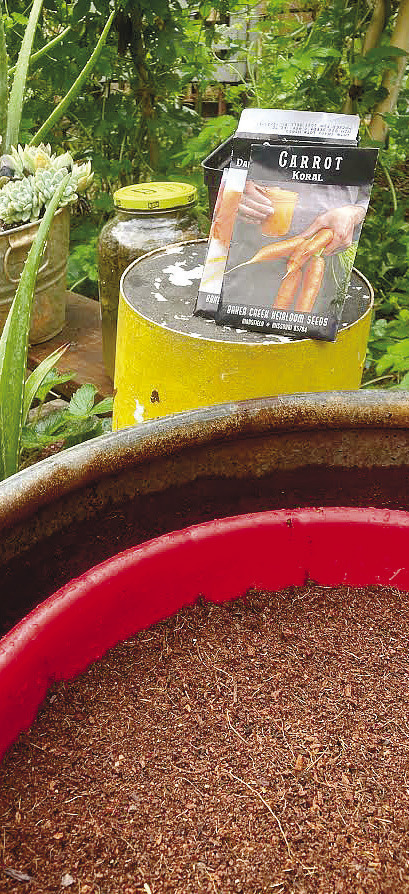
Remember this: “Whoever soweth sparingly shall reap also sparingly, whoever soweth bountifully shall also reap bountifully.” 2 Corinthians 9:6 Recently, I was reading The Complete Book of Garden Magic by Roy E. Biles, who, in regard to his qualifications to author such a book, referred to himself as “…the duffer who has blundered and found a way out…” Here I sit, poised to try and impart good counsel on the matter of sowing, feeling very similar.
Seed sowing is a fussy business. Each different crop requires attention to what conditions that particular seed needs to germinate properly. Some seeds will not germinate above 80°f, some will not germinate below 80°f!
Though the back of a seed packet lists planting times, seed depth, and plant spacing, the range of USDA zones in which the plant thrives and the number of days from planting until harvest are of upmost importance in terms of garden planning.
This all goes out the window, though, when you collect your first dry-shelled beans to keep for winter, or seeds from that “best-one-all-summer” tomato sandwich – and your recall of what variety it was perhaps – but the seed packet has long since crumpled inside the pocket of your gardening trousers, swam through the wash, and got discarded from the lint trap in a million pieces.
Which brings me to some solid sowing advice for when the packet is gone:
• Write it all down. Don’t just make a marker for what crop is in that tray; name the variety and the date it was sowed. Also mark in your notebook: variety, USDA zones, days until harvest. Record from the packet as well, dates of sowing, germination, planting, and the range of harvest dates. It is better to augment the packet information with data specific to your garden than to replicate it through trial and error.
• Place seed at twice the depth of its size. Whatever the longest dimension of the seed is, place it vertically, and at twice the depth of that measurement.
This is very old advice.
• Tiny seeds like basil need to be spread thinly across the surface of packed medium in a growing tray, then thinly covered over.
• Shallow rooted seedlings in open trays are superior to individual cell trays. Conversely, deep-rooted seedlings like tomatoes are better started in a deep cell tray.
• Beans and peas require pre-soaking.
• Chlorine in tap water will reduce germination rates.
• Get a good book on sowing. I refer to a well-worn copy of Seed Sowing and Saving, by Carole B. Turner, but there are countless other competent guides.
• Sow more than you will plant. Select only the strongest seedlings and you will insure good seed stock in future generations of your saved seed.
Until next time, Your Eatonton Gardenerd This week’s jobs: Sow carrots!
– Pot-up seedlings from trays to containers – Give liquid feed to container- plants weekly.
Hey Gardenerds! Send tips and questions to: garden.nerd.31024@gmail.com