
Drivers who frequent two specific roads on the northeast side of Putnam County will soon find those roads easier to travel.
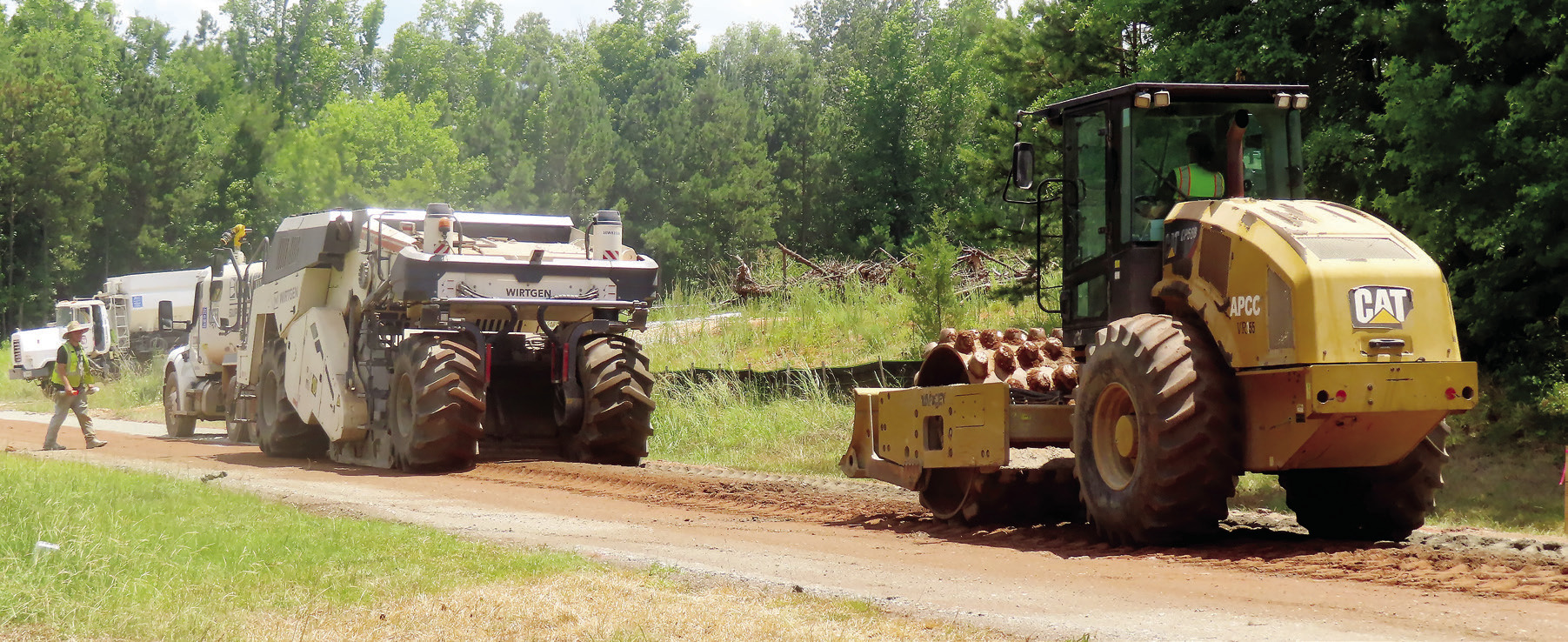
Scott Road and Sammons Industrial Boulevard are currently being repaved by Pittman Construction Company.
“The paving on Scott Road has started, so avoid the area and expect delays,” Putnam County Manager Paul Van Haute said at the June 25 Board of Commissioners meeting.
Noting that the county and contractor had worked extensively with the hardening company provider and the Department of Transportation to determine the best method and materials for the roads, Van Haute said the old asphalt had been totally removed, and the ground regraded.
“So it’s pretty impressive to go out there and watch a 6-ton roller not move the first crumb of dirt out there,” Van Haute quipped.
He said Scott Road traffic primarily consists of automobiles cutting through between GA-44 and Harmony Road, as well as residential and small business traffic.
Because Sammons Industrial Boulevard is the location of one of Putnam County’s trash convenience centers, residents frequently traverse it, and large trucks also constantly travel there.
“There are several companies on Sammons Industrial Boulevard that deal with a lot of weight,” Van Haute said. “Including a marble company, brick distributor, tree debris, commercial trash hauler, and the county recycling center.”
The heavy trucks' weight and high frequency caused significant asphalt ruts, cracks, and large holes.
In an earlier presentation at the March 19 Board of Commissioners meeting, Van Haute said the labor and material costs for repaving both Scott and Sammons Industrial roads totaled $1.2 million.
The material costs included using an Open Grade Interlayer (OGI) layer underneath the finish layer of asphalt on both loads. Also known as Flex Mix, OGI has a high asphalt cement-tostone ratio, creating a strong yet flexible asphalt that prevents cracks from spreading.
According to the Georgia Department of Transportation, the finish layer of asphalt will have a 12.5 mix surface, which is for higher truck traffic volumes.
“If it does work, we’ll have a better understanding of what all we can do going forward,” Van Haute said in the March meeting minutes. “ We need a way to do full-depth reclamation on our roads at a cost that won’t cripple our TSPLOST 2 budget. Roads will be identified and made known to the BOC, indicating which roads need which materials, so each road will be custom designed for the condition of the road.”
Commissioners Daniel Brown (District 2), Steve Hersey (District 3), and Chairman Bill Sharp unanimously approved the repaving contract on March 19.
In other business at the June 25 BOC meeting, Van Haute reported the results of a previously-requested traffic study on Parks Mill Road.
The motion for the study was made at the April 5 BOC meeting. Resident Mike Judy commented that Parks Mill Road is becoming “a north and south thoroughfare,” and Hersey proposed reducing the speed limit from 55 mph to 45 mph.
Sheriff Howard Sills also commented at that meeting, saying a traffic study was required. Sills said Parks Mill Road was not one of the roads that GDOT licensed him to run radar on, so speed could not be enforced.
Sills also reported that there had been 21 accidents on Parks Mill in the last five years, but only one of those was related to speed.
A motion was made by Hersey to authorize Van Haute to conduct a traffic study on Parks Mill Road, and passed with aye votes by Brown, Hersey, and District 4 Commissioner Jeff Wooten; District 1 Commissioner Gary McElhenney voted no.
At last week’s meeting, in his report on the study, Van Haute quoted the engineer as saying, “My recommendation is that the speed limit on Parks Mill Road remains at 55 mph.”
“So they have confirmed what Frazier’s data provided and what the sheriff provided in his report on that road,” Van Haute said. “I believe it was that 85% of the time, people were following the rules and operating safely.”
No further discussion or action was made regarding Parks Mill Road.