
The Putnam County Charter School System (PCCSS) is preparing to approve a fiscal 2027 budget that relies heavily on local funding while absorbing rising personnel, health care and other mandated costs.
PCCSS Superintendent Derick Austin presented the proposed budget at 1 p.m. Aug. 20, during the first of two public presentations that day at the Board’s administrative building near the county’s primary school in Eatonton.
Austin said approximately 90% of the district’s budget is tied to personnel costs, including salaries, benefits, and other employee-related expenses. Among the largest increases are retirement and health insurance costs, neither of which the district has much control over, he added.
The district’s Teachers Retirement System (TRS) contribution has risen from 10% in 2012 to 22.32% today, Austin said. He added that the Board has budgeted just under $6.3 million for TRS in the coming year, compared with less than $2 million in 2012.
Health care is another major expense. The district is budgeting about $10.4 million for employee health insurance, with the potential cost rising to $11.6 million if all eligible employees enroll.
“When you look at both healthcare and TRS combined, we’re at just under $17 million of our budget,” he said.
Other pressures include salary increases, inflation, energy and fuel costs, supply chain issues, and expenses associated with school safety. Austin also pointed to several state-mandated positions — including mental health personnel, literacy coaches and student advocacy coaches — for which the state does not fully cover the costs.
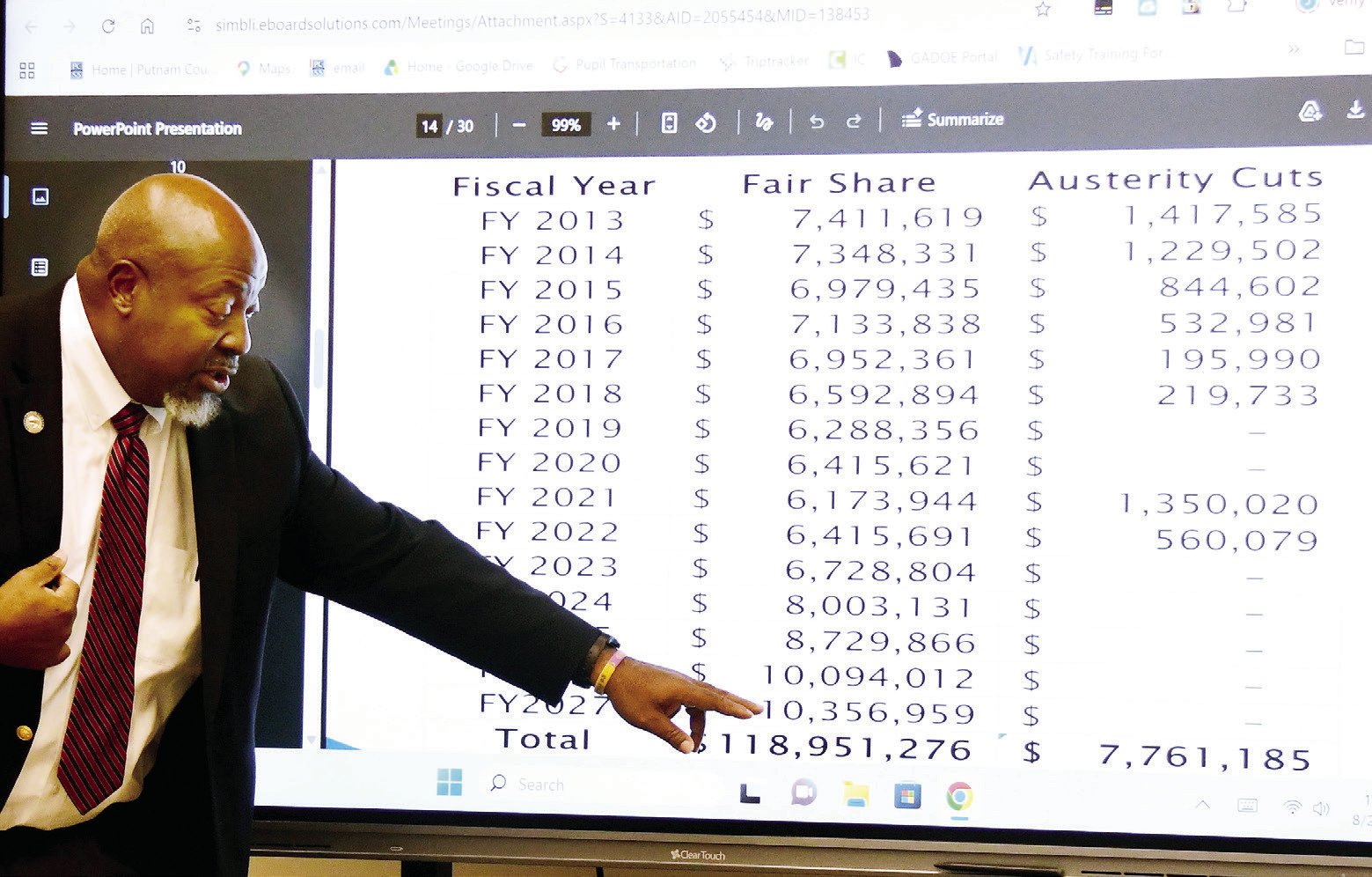
Putnam’s classification as a “relatively wealthy county,” Austin explained, creates another financial challenge. He said the state’s funding formula reduces the amount of money PCCSS receives through what is known as the “five-mill share.” One mill equals $1 in tax for every $1,000 of assessed property value.
For the coming budget year, Austin said approximately $10.3 million is being withheld from PCCSS under that formula.
“That is money we earn that the state does not give us because they consider us being wealthy,” he explained to about a dozen people attending the Thursday afternoon meeting.
Putnam County also receives no state equalization funding, he added. The funding is intended to provide additional support to districts considered less wealthy.
Austin said the funding structure contributes to Putnam’s unusually heavy reliance on local revenue. About 70% of the district’s budget comes from local sources, he explained, compared with the original goal of the state’s Quality Basic Education Act, which envisioned 80% of education funding from the state and 20% from local sources.
“The formula has never worked that way for us,” Austin said.
As a result, PCCSS is proposing to maintain its school property tax millage rate at 11.98 mills, compared with a rollback rate of 11.57 mills. Austin said the higher tax digest means the district can generate additional revenue without increasing the millage rate.
He emphasized that an individual property owner’s school tax bill would not necessarily increase unless the property's assessed value of the property increases.
Austin also discussed the role of ESPLOST, the Education Special Local Option Sales Tax, which can be used for capital improvements and equipment but generally cannot be used for regular operating expenses. The district has used ESPLOST revenue for technology, transportation, maintenance and construction, he said, including construction of the new elementary school near Putnam General Hospital and the middle school.
Despite the financial pressures, Austin stressed that the district continues to invest in programs designed to prepare students for college and careers. Those include Advanced Placement courses, Georgia College Early College and career certification programs in areas such as welding, firefighting and paraprofessional education.
PCCSS currently serves 3,058 students from Head Start through 12th grade, representing an enrollment decline of about 40 students from last year, Austin said. He noted that PCCSS routinely sees students arriving from other districts and private schools.
Austin said the district faces additional costs because it must educate every child who enrolls, including students with limited English proficiency and those with disabilities or significant medical needs.
“We’ve got to take them all, and we’ve got to take care of them,” he said.
While the budget remains the focus, Austin said the district’s academic and career programs demonstrate that the local investment is producing results. He pointed to high graduation rates, AP performance, college partnerships, and career certifications as evidence that students are succeeding despite the challenges facing PCCSS and the community.
A second budget presentation was held Tuesday night at the PCCSS building. A third and final budget hearing is expected before the Board considers final approval of its FY27 budget.