
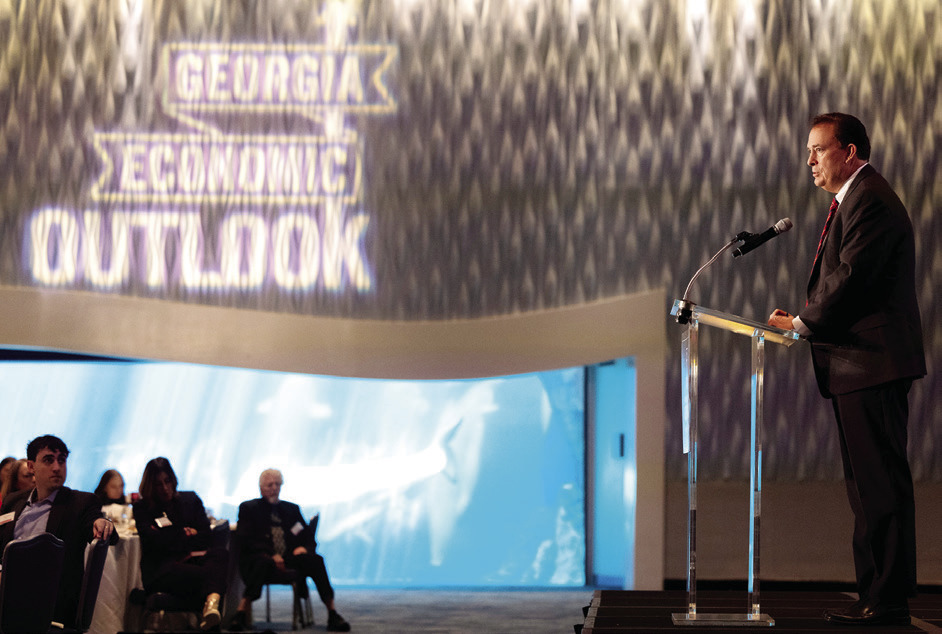
The dean of the University of Georgia's Terry College of Business predicted last Friday that Georgia’s economy will continue growing next year but at a slower rate than this year. However, the state will continue outperforming the nation, which economic forecasters project will grow by 1.6% in 2025.
Georgia’s economy is projected to grow by 2.4% in 2025, down from 3.1% this year, Ben Ayers told a packed ballroom of business leaders at the Georgia Aquarium in downtown Atlanta.
“Because the 2025 economic slowdown is due to a deliberate policy shift and not economic shock or a factor outside our control, we think the slowdown will be gradual and not last long,” Ayers said.
The major driver behind Georgia’s slowdown is the Federal Reserve’s move in 2022 to constrain lending to control inflation. That successfully shrank inflation from 8% in 2022 to 3% this year and a projected 3% in 2025.
As a result of lower inflation, the Fed began to cut interest rates in September.
“We expect additional rate cuts in 2025, and quantitative tightening will end,” Ayers said. “These policy moves, the resilient labor market, and recent economic success will ensure that Georgia’s economy grows throughout 2025 and accelerates in 2026.”
Ayers predicted Georgia’s unemployment rate would increase slightly from 3.7% to 4%, lower than the 4.3% jobless rate expected at the national level. He said the increase in unemployment will be due to less hiring rather than layoffs.
Charlotte-based economist John Silvia, president of Dynamic Economic Strategy LLC, said the national economic outlook for 2025 is cloudy because it remains unclear what the international President-elect Donald Trump campaign promises.
Trump has pledged further tax cuts in addition to the reductions he steered through Congress during his first term in the White House. He has also advocated aggressive government deregulation, stiff import tariffs, and a crackdown on illegal immigrants.
But Silvia said higher tariffs threaten to increase the price of products that can’t be produced in the U.S., which flies in the face of Trump’s promise to cut inflation.
“You simply cannot grow bananas in Michigan,” he said. “You can’t produce coffee or cocoa.”
Silvia said deporting huge numbers of illegal immigrants would threaten American industries that depend on immigrant labor, including agriculture (the number-one industry in Georgia), manufacturing, and construction.
“We’re not going to get the job done if you tell me all these immigrants are going to have to leave,” Silva said.
Silvia also predicted that U.S. inflation is unlikely to return to the pre-pandemic level of 2%, while interest rates suggest that it is unlikely to reach 4%.