
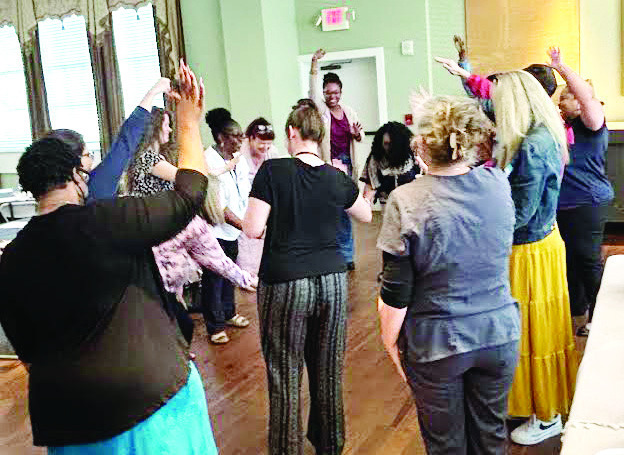
The Putnam County Family Connection Collaborative (PCFCC) met for its monthly meeting on April 17 at The Plaza Arts Center reception hall, where approximately 15 community members involved in education, healthcare, local business, and more discussed rising rates of student absenteeism.
Before introductions, Georgia Family Connection Partnership (GaFCP) Regional Manager Adam Swymer opened the meeting with an engaging group activity. Two volunteers were asked to leave the room while the rest of the group was told their assignment: pretend to wash an elephant.
Gathered in a circle, the attendees acted out washing an elephant as the two volunteers reentered the room. These two were not told what the others were doing and had to guess what was going on and join in. Afterward, everyone sat back down in their groups.
Swymer asked the two volunteers to explain what they thought the group was doing before he revealed the activity’s metaphor. The two guessed they were pretending to wash a car.
“Our activity here represented kind of the idea of not making the class, coming in, maybe having missed content and not knowing what was going on,” Swymer explained, saying it represented how a student who missed school may feel when they rejoin their classmates. They might feel isolated or outcast by their lack of knowledge about what has been taught during their absence, he added.
Following the activity, everyone introduced themselves, and last month’s meeting minutes were approved. Next, clips from a Get Georgia Reading webinar with Cecelia Leong of national nonprofit Attendance Works were shown to shed more light on the issue and get the conversation going.
Attendance Works’ mission is to promote equal opportunities to learn and advance student success by reducing chronic absence. Leong pointed out Georgia’s data showed nearly one in four students was chronically absent from school last year. “These are really high rates,” she said.
“When you have high numbers in your classroom who are missing, it has a ripple effect. Some of the research … really showed that somewhere around 20 percent chronic absence in a school is when you started seeing the effects on the students who weren’t chronically absent,” Leong said. “They’re affected because their learning is disrupted. Their project is disrupted. Their friendships are disrupted. As a child, I looked forward to sitting with my friends at lunch and playing with them in recess. Imagine if you couldn’t count on your friend being there from day to day. How would that feel?”
Sixty-six percent of students attended a school with 20 percent or more absenteeism in the 2021-2022 school year, versus only 25 percent before the pandemic. The reasons for students being chronically absent were divided into four categories: barriers, aversion, disengagement, and misconceptions.
Barriers may include chronic illness, trauma, poor transportation, family responsibilities or a negative home situation, housing and food insecurity, or community violence.
Aversions may be academic or behavioral struggles in school, social or peer challenges, anxiety, an unwelcoming school climate, or a parent’s negative educational experience.
Disengagement could stem from a lack of enrichment opportunities, no meaningful relationships with adults in school (especially given staff shortages), a lack of challenging culturally responsive instruction, or a lack of academic and behavioral support.
Common misconceptions that may lead to student absenteeism are that sporadic absences are not a problem, missing a couple of days per month does not affect learning, suspensions do not count as absences, or attendance only matters in the older grades.
After discussing why a student may not be coming to school, Leong described ways to combat the problem. Critical strategies for improving attendance included better family engagement, student connectedness, health and safety, and community partnerships.
Among the reasons, the group believed students were missing so much school and what puts a student at a higher risk for not coming were taking care of younger siblings, parents working long hours at their jobs, and transportation problems.
Another possible problem is parents not knowing the guidelines on when a child needs to stay home or go to school when it comes to illness.
Leong said parents were collectively taught during COVID to keep children at home if they even sniffle or have a light cough. She said healthcare workers typically tell her they’ve gone through post-COVID guidance “everyone now knows they can go back to school.”
“And what we found is, no, everyone doesn’t know this,” Leong stated. “Parents are really confused about when they should keep their child home and when they should send them to school. And staff are confused about when to send a child home or let them stay at school.”
Lastly, the group was asked to talk in groups about what they had learned concerning absenteeism. Concerns included a lack of community awareness, issues with transportation timing, and few incentives. Another issue was the disconnect between school and the workforce for older students, who frequently perceive more benefit in working than learning.
The group hopes to help ease this problem by spreading awareness of absenteeism’s negative effects and by utilizing local solutions.
For more information about the collaborative, visit putnam.gafcp.org.